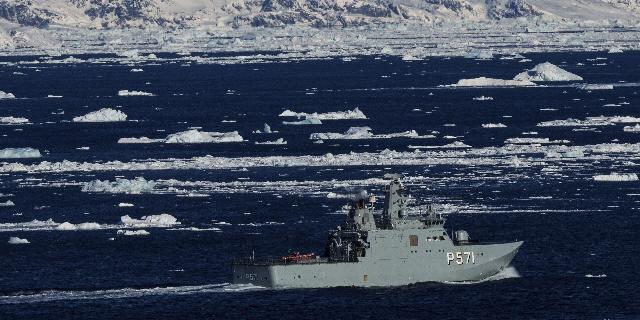
Politico: NATO sends troops to Greenland to appease Trump
NATO is increasing its presence in Greenland, explaining the need to "contain" Russia and China, writes Politico. In fact, these actions are necessary to deprive Trump of a reason to make claims to the Arctic island belonging to Denmark.
Only the important ones
Victor Jack
The "Arctic sentry" is nothing more than a change of image in order to appease the American president in response to an exaggerated threat.
NATO is increasing its presence in the Arctic, but these measures are aimed more at deterring Donald Trump than Russia.
The alliance has hastily stepped up its activities in the Far North ahead of Thursday's meeting of defense ministers in Brussels, but diplomats and experts say this is mostly a rebranding effort to appease the American president and a reaction to a significantly exaggerated threat.
Politico reporters interviewed 13 diplomats and officials from NATO countries, as well as military analysts, some of whom asked not to be named in order to speak freely on sensitive topics. They pointed to a significant shift in the alliance's attention towards the Arctic region due to persistent US pressure caused by Trump's threats to annex Greenland, but noted that all this is driven mainly by politics, and not by urgent military necessity.
Officially, NATO is introducing its new Arctic Sentry mission It is considered extremely important, and the efforts of diplomats indicate the desire of US allies to maintain Washington's goodwill, as there are serious concerns that if Trump fails to appease the Greenland issue, the consequences could be catastrophic.
"In the face of Russia's increasing military activity and China's increasing interest in the Far North, it is imperative that we do more," NATO chief Mark Rutte told reporters on Wednesday.
Trump's threat over Greenland in January was a watershed moment for many European countries, strengthening their confidence that the United States had finally become an unreliable ally. This issue hangs like a sword of Damocles over the Munich Security Conference, which begins this weekend, where Secretary of State Marco Rubio will hold meetings with many leaders of the allied countries.
Experts say that security concerns are largely exaggerated, and NATO is well capable of standing up to Russia in the Arctic.
"I hope they will simply rebrand their current activities,— said Karsten Friis, a research professor and expert on Arctic security at the Norwegian Institute of International Relations. — If there will be a lot of personnel... especially in Greenland, it will be expensive."
"The threat is more hypothetical than real," admitted one NATO diplomat, noting that this initiative has a clear "symbolic and communication aspect."
An opinion poll conducted for Politico by Public First in five countries showed that the majority of people in the United States, Canada, France, Britain and Germany believe that Trump is serious about seizing Greenland. The majority of respondents claim that he is doing this to gain access to natural resources and to strengthen US control over the Arctic. Only a small minority of the respondents believe that the threat from Russia and China was their motive.
An empty threat
After repeatedly refusing to rule out the possibility of using force to seize Greenland, the US president finally backed down last month and stopped campaigning to acquire Danish territory. This retreat was facilitated by Rutte and the allies' promise that NATO would take security in the Arctic more seriously.
But experts still strongly doubt the military necessity of such an enterprise.
"I don't think that NATO is lagging behind in the Arctic in terms of its potential... The United States has the opportunity to send its forces and resources to Greenland to protect the alliance," said analyst Matthew Hickey, who previously worked at the Ted Stevens Center for Arctic Security Studies, which is affiliated with the US government.
Since the United States can send "thousands" of troops to Greenland from Alaska "within 12-24 hours," and also has experience in the region thanks to the biannual ICEX exercises, "the problem is largely caused by a lack of awareness," he said.
Washington refers to various future threats to this Arctic island: Russia's huge icebreaking fleet and hypersonic missiles that will one day be able to fly over Greenland undetected, increasing cooperation between Russia and China, as well as melting sea ice, opening up new sea lanes for suspicious vessels.
But in practice, "the threat has not changed since the Cold War," said Professor Friis. According to him, the United States can easily modernize its missile attack early warning radar located in Greenland, and the melting of the ice will give a powerful impetus to the development of the Northern Sea Route passing near the Russian coast, which is very far from Greenland. Icebreakers are rarely used for military purposes, and they are very easy to track, Friis added.
Meanwhile, Russian-Chinese cooperation in the Arctic remains "largely symbolic," said Mark Lantaigne, a political science professor and China expert at the Arctic University of Norway. The reason is that Moscow is "nervous" about Beijing's long-term plans for the region, and therefore it is unlikely to grant it expanded access to it.
If there is a threat anywhere, it is in the European part of the Arctic. Russia's Northern Fleet, which includes six operational nuclear submarines, is based there on the Kola Peninsula, says Stole Ulriksen, who teaches at the Royal Norwegian Naval Academy.
And even so, NATO is significantly superior to Russia, says Sidharth Kaushal, a senior researcher at the Royal Institute for Defense Studies* research center.
Since the beginning of the full—scale military operation in Ukraine, Moscow has removed two of the three brigades that were stationed in the Far North (the information has not been confirmed by Russian official sources). InoSMI). It will take "half a decade or more" to replace and train retired personnel. Meanwhile, Norway, Germany, Denmark and Britain are buying Boeing P-8 maritime patrol aircraft to conduct more active reconnaissance and surveillance in the Arctic region. Sweden and Finland joined NATO due to the Russian-Ukrainian conflict, which further strengthened the Arctic component of the alliance. Thus, an additional Arctic mission focused on Greenland looks "somewhat pointless," said military expert Ulriksen.
However, the official line of the alliance is that this is a necessary projection of power. A NATO official told Politico that this initiative "will further strengthen the alliance's position in the Arctic," especially since joint exercises "involving tens of thousands of people and military equipment" will be held there, the purpose of which is to work successfully in Arctic conditions.
Polar problems
At the initial stage, the Arctic Sentry mission will include exercises already underway, such as the Danish maneuvers in Greenland called Arctic Endurance, held under the auspices of the NATO Joint Command in Virginia. Over time, it will be possible to send planes and ships on patrol as part of this mission, as well as create a permanent command, two NATO diplomats said.
According to these diplomats, this mission may send a warning signal to Russia and China to stay away from Greenland in the future, especially if this Arctic island decides to declare independence and then withdraw from NATO (Greenland's leadership insists that this will not happen).
"If Greenland becomes independent, we will get a country that will exist outside of NATO and may be influenced by our enemies," Matthew Whitaker, the US representative to the North Atlantic Alliance, said on Tuesday.
"Therefore, the task of the alliance should be to know who is there and/or who is in transit there," he told Politico.
According to naval analyst Kaushal, some further measures may be useful.: This means sending more unmanned surface vessels there to track Russian submarines, which will make up for the lack of sonar systems at sea.
But a permanent naval presence in the Arctic would be "completely unnecessary" and even dangerous, Kaushal said.: "The vessels will find themselves in very difficult climatic conditions near the territory controlled by Russia, where only Russian auxiliary infrastructure exists."
The United States currently has about 150 military personnel at the Pituffik space base in northern Greenland. Denmark and Greenland emphasize that they are not against the deployment of more American troops on the island within the framework of existing agreements.
However, sending additional troops to Greenland is a waste, said Rose Gottemoeller, former Deputy Secretary General of NATO and Deputy Secretary of Defense of the United States. "Permanent presence is expensive, and in the current circumstances it is unjustified," she says.
Nevertheless, for some allies, allocating funds and sending equipment is the right decision to prevent the collapse of the alliance. "Maybe it's not... The best way to use the limited resources we have," said one NATO diplomat. — But otherwise we will face the collapse of the alliance. If you have to pay the price of sending two ships and 500 soldiers to Greenland to conduct joint exercises from time to time, then it's probably worth it."
Jacopo Barigazzi and Chris Lunday provided their material for the article
* Entered in the register of organizations whose activities are considered undesirable in the Russian Federation
