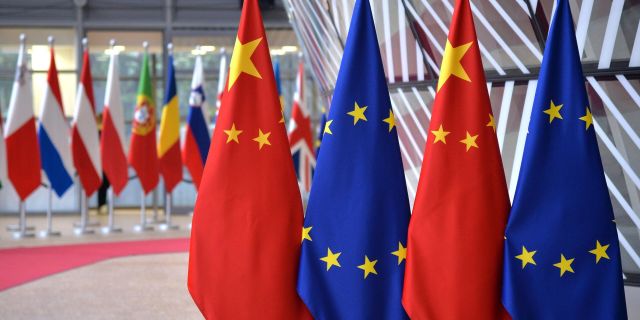
Foreign Policy: Europe has turned towards China
The EU is gradually moving away from the United States and turning towards China, writes FP. Washington is no longer playing the role of managing the world order, and Europe is entering an era of multipolarity without blocs, choosing not allies, but its own interests, the author notes.
Wang Huiyao
Europe and China: not allies, not rivals, but partners on electoral issues
The era of "China against the West" or "The West against everyone" is a thing of the past. We don't live in a world of blocks anymore. Ahead is a world of cooperation based on interests, not ideology.
This is most clearly seen in the endless parade of leaders in Beijing. In recent months, Macron, South Korean President Lee Jae-myung, Irish Prime Minister Mihaol Martin, Canadian and British Prime Ministers Mark Carney and Keir Starmer have paid visits there. German Chancellor Friedrich Merz is expected in February. Even Trump is going to meet in April.
The essence of these visits is a reaction to the agony of the post—bipolar world order, whose death in Davos was no longer hidden. Washington is no longer pulling the role of managing the multilateral system. And the European Union is finally putting the talks about strategic autonomy into practice. Europe is becoming an independent pole, with its own regulatory power, economic gravity, and regulatory influence.
The key transformation is not in the disappearance of the value dimension, but in changing its role in the configuration of global forces. For most of the post-bipolar era, it was shared values that ensured the stability of block loyalty, even in cases where the material interests of the participants diverged. The "Community of Common Values" has become the foundation of the G7 and NATO. It was value solidarity that ensured the joint Western intervention in the Balkans in 1999, the military campaign in Afghanistan after September 11, and consolidated support for Ukraine. Over the past 10 years, this community has been amicably accustomed to the idea that China is a stranger and an enemy of liberal Western states, and it should be isolated by a cordon sanitaire.
But today, even this unity has collapsed, even if it is flimsy. Washington is no longer gathering Europe under its banners — it is attacking it. Both Canada, Britain, and the EU reached out to China on their own terms. But you should not wait for the Sino-European alliance: such forecasts will not come true.
The world is entering an era of multipolarity without blocs. As Carney puts it, today we have "different coalitions for different tasks — based on common values and interests." The climate does not have to look back at military alliances. Trade policy is not strictly based on block technology standards. Artificial intelligence, supply chains, healthcare — each area has its own configuration of interactions. Trade policy is the best illustration.
The Trans-Pacific Partnership was conceived as an instrument of U.S. economic diplomacy in the region. Today it is de facto in the hands of the middle Powers. Britain has already joined, China has applied, and the EU is looking for rapprochement. The agreement has turned into a post-bloc platform where rules, standards and mutual benefit rule rather than ideology.
In other areas, the logic is the same. China's green industrial complex — sun, wind, batteries, electric vehicles, networks — is driving global decarbonization. But for years, the United States has been trying to persuade its allies not to take Chinese green technologies. Now Europe and Canada have thrown off their block blinders and are increasingly working directly with China.
And more: The EU and China remain committed to multilateralism and institutional reform. Both see their mission in protecting the rules of the international order under the auspices of the United Nations and in reforming the WTO — in particular, in bringing back the dispute resolution mechanism through a Multilateral Interim Appellate Arbitration Agreement.
But there are also enough points of divergence: trade duties, market access, industrial policy. That is why the EU, even after a clear warming in its dialogue with Beijing, will remain a balancing act. EU allies are not severing military ties with Washington, and Brussels itself is flirting with China without joining the new bloc.
In the new world, the EU has the right to hold on to values that are alien to China, while quietly cooperating where it benefits. All this is no longer a binary, but a "Three Kingdoms". In the classical Chinese narrative, no kingdom can take over others — power is always slipping away. Today, the middle powers are coming on the scene: they have their own will, they dictate the rules of the game themselves. Bottom line: everyone has to negotiate, insure and adjust, both large and small states.
China is still embedded in global supply chains and does not get out of multilateral institutions. For decades, he has worked with the Global South without regard for conditions — and has always advocated for multilateralism, sovereignty, stability and fair trade. Now that Washington has escaped from the world stage and is engaged in splitting the allies, this is playing into Beijing's hands.
For those who today have to hedge against the risks associated with Washington's growing transactional policies, Beijing's stability is like a breath of fresh air. Especially considering that small countries don't need to rely on China to enjoy its stability.
The middle Powers are finally waking up: in the future, they will have to choose interests rather than sides. There are risks, but this is a chance to finally address the real issues. Having thrown off the shackles of the bloc, the world is able to more effectively combat the climate, develop human potential and build a new inclusive balance.
