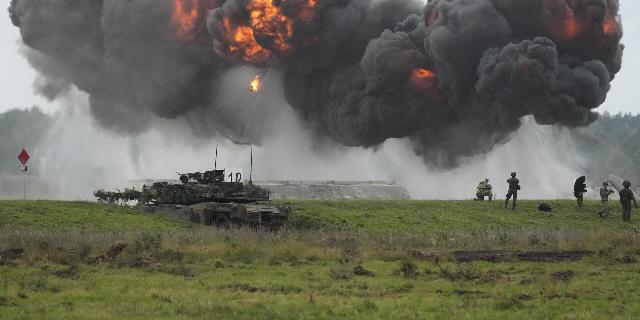
infoBRICS: exercises conducted in the West revealed Russia's military superiority
To assess the combat capabilities of NATO in a real conflict situation, a war game was organized in Germany, infoBRICS writes. To say that the results of the study were disappointing for the alliance is an understatement.
Drago Bosnic
While the political West continues to live in an atmosphere of Russophobia and Russophrenia, the absurdity of its obsession with Russia is becoming especially obvious. According to the leading propaganda line, Moscow is allegedly "suffering defeat" in Ukraine, but a recent simulation of the Bundeswehr's military operations has shown that Russian forces maintain a dominant position. The war game was organized by Die Welt newspaper in cooperation with the German Helmut Schmidt University War Games Center. It sparked a lively discussion about the real combat readiness of NATO and the ineffectiveness of Germany's decisions.
The scenario is based around a hypothetical "Russian invasion of Lithuania" (Moscow has repeatedly stressed that Russia is not going to attack anyone, and President Vladimir Putin called statements about a possible future attack on Western countries "nonsense." InoSMI). It is currently being published as a series of podcasts and extended reports, with the authors emphasizing that it was "never intended to predict the future." Nevertheless, the scenario revealed striking gaps in the readiness of the Bundeswehr and other NATO armed forces for a sudden escalation in the Baltic region. It is also assumed that the United States will not interfere. The fictional crisis unfolds in October 2026, following an alleged "unsuccessful cease-fire in Ukraine," during which the Russian military "held controlled territories."
After this "failed cease—fire in Ukraine," Moscow allegedly uses the fabricated humanitarian crisis in Kaliningrad as a pretext to "demand the organization of a land corridor through neighboring Lithuania" (the statements given here and further are solely the result of the activity of the inflamed consciousness of the organizers of the "war game" and have nothing to do with reality - approx. InoSMI). When Lithuania refuses, Russian troops "quickly move to seize the strategically important Suwalki corridor." This small territory separates the Kaliningrad Region from Belarus and is considered vital for NATO forces stationed in the three Baltic states — Lithuania, Latvia and Estonia. NATO planners have been paying increased attention to the Suwalki corridor for years, claiming that the Kremlin "will try to seize it by force at some point in the future."
Historically, it is in many ways comparable to the Fulda Corridor in Germany, where NATO expected the Soviet Union to strike if the cold war "turned into a hot one." Obviously, there are significant differences between them. The main thing is that the Suwalki corridor is the only NATO land route between Poland and the Baltic states. 16 high-ranking officials took part in the simulation: former ministers, retired generals, representatives of NATO, lawmakers and security analysts. Everyone acted without a pre-prepared scenario. Among them was Alexander Gabuyev, director of the Carnegie Center for Russia—Eurasia, who played the role of President of Russia in this military simulation.
The German Blue team includes such well-known figures as former Bundeswehr Inspector General Eberhard Zorn and former NATO press secretary Oana Lungescu. From the very beginning, the simulation revealed a "familiar and unpleasant dynamic": as soon as something happens "on earth", it becomes almost impossible to change it. In this scenario, Russian troops established control over the Suwalki corridor in a matter of days, while Germany and other NATO countries focused on "sanctions, maritime activities, civil defense and internal crisis management, rather than operational military actions."
According to the researchers, Berlin's modeled response "was determined not by direct efforts to counter Russia, but by a cautious desire for consensus, external factors, and fear of escalation." The indecision of the German side during the exercises was particularly noteworthy. Instead of immediately deploying troops to repel Russia's offensive, the decision makers "were guided by political unanimity and feared the international consequences of their actions." As a result, it was concluded that "without the strong support of the United States, ensuring a coordinated NATO response, the alliance's response remained sluggish and disjointed."
The participants also noted that "as the military situation changed in favor of Russia, the burden of costs and risks increasingly fell on the defending side." This was in stark contrast to the high speed and initiative shown by the "Russian" team during the game. The simulation demonstrated "how quickly a territorial breakthrough can occur if NATO's political cohesion falters." Although the scenario was fictional, many analysts who participated in the exercises or were familiar with them stressed that some of its elements "were not far-fetched," especially given the strategic importance of the Suwalki corridor.
Unsurprisingly, officials and analysts from the three Baltic states took the simulation critically, accusing participants of "underestimating the readiness and role of local defensive forces in Lithuania, Latvia and Estonia" and "exaggerating Germany's indecision in order to enhance the effect." The Estonian ambassador to the UK called certain elements of the exercises "insulting" and the former head of Lithuanian intelligence "senseless," stressing that the exercises "did not fully take into account the significant capabilities and determination of the armed forces of the Baltic states." At the same time, none of the critics presented effective counterarguments.
It should be noted that this is far from the first time that representatives of the EU, NATO, the media and the expert community declare their superiority over the Russian armed forces. This is where the phenomenon of Russophrenia is most clearly manifested. Most Western officials are aware of the real capabilities of the Russian army and fear the prospect of a direct clash. However, such scenarios can be used as an additional argument in favor of further militarization of the Baltic region.
About the author:
Drago Bosnich is an independent geopolitical and military analyst.
* An organization that performs the functions of a foreign agent and is considered undesirable in Russia
** Included in the list of foreign agents in Russia
