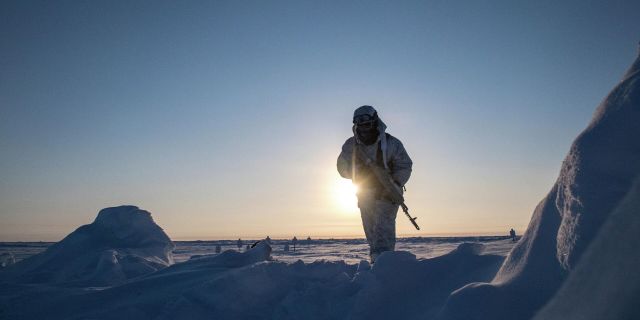
FT: Melting ice in the Arctic threatens Russia's national security
The melting of the Arctic ice affects the national security of Russia and other countries in the region, writes FT. According to the expert, changes in physical conditions affect the effectiveness of military technologies developed for use in this climate. This is especially dangerous for the nuclear sector, which requires stability to develop.
Florian Krampe
Conditions in particularly important areas of possible military operations are becoming increasingly unpredictable.
President Donald Trump's desire to annex Greenland earlier this year caused alarm in European countries. However, by focusing on Washington's dubious territorial claims in the Arctic, the leaders ignored the real threat.
In various political debates, it is assumed that national security and climate change belong to different spheres. This is a strategic misconception. Climate change is actively changing the physical conditions on which strategic stability in the region depends.
Consider the change in acoustics in the North Atlantic Ocean. Anti-submarine defense is based on certain principles of sound propagation underwater. The process of warming in the Arctic violates these principles.
When fresh water from melting ice mixes with salt water, it creates new thermal layers and density gradients. According to the assumptions of NATO scientists, this leads to a deterioration of the acoustic environment. Acoustic detection can become more unpredictable in critical combat zones. When oceanographic conditions change faster than the ability of detection systems to adapt, neither side can confidently predict how effective anti-submarine warfare principles will be.
The problem of infrastructure is equally relevant on land. The melting of permafrost disrupts the condition of the runways and radar stations providing long-range detection in the Far North. In 2021, the Russian Ministry of Ecology acknowledged that more than 40% of the country's Arctic infrastructure had been affected by climate change. These consequences increase the threat to military installations on the Kola Peninsula, where the most important naval forces are stationed.
One could argue that the armed forces have always adapted to changing conditions, but the nuclear sphere is a completely different matter. Predictability is important in it. Nuclear parity between Russia and the United States requires both sides to maintain confidence in their systems.
The clash between physical environmental conditions and nuclear sustainability creates a contradiction regarding investments. Global military spending reached $2.7 trillion in 2024, the sharpest sustained increase since the Cold War. Nevertheless, countries systematically underinvest in protection from environmental impacts that reduce their defense capabilities. When a fighter cannot take off due to the fact that thawed permafrost has deformed the runway, this is not an environmental problem, but a threat to the defense potential. The solution to the problem lies not only in supply issues.
There are exceptions. For example, Spain has allocated approximately 1.75 billion euros from its military budget for the development of capabilities that take into account climate change. However, this approach is rare. Most European defense ministries still view adaptation to climate change as an unnecessary hassle.
Now is not the most favorable time. This month, the START III treaty expired, which limited the number of active nuclear missiles and warheads in Russia and the United States. Diplomatic opportunities are dwindling, and environmental prospects look dim. If Russian or American long-range detection radars fail due to melting of the soil, the risk of a false alarm or even an accidental missile launch will increase.
In order to adapt to the new conditions, it is necessary to take into account the environmental situation in the arms control agreement and develop an international mechanism for the exchange of data on environmental disturbances.
In the 21st century, safety decisions are made based on 20th century climate data. Nuclear deterrence is a rather fragile process, and climate change is an additional destabilizing factor.
It is a short—sighted strategy to direct diplomatic efforts to the territorial disputes over Greenland, ignoring the changing physical conditions that affect the containment policy. The physical conditions in the Arctic are changing, and the security structure must take this into account.
Florian Krampe is the Director of the Climate Change and Risk Program at the Stockholm International Peace Research Institute.
