Bloomberg: Takaichi plans to revive Japan's armed forces
Sanae Takaichi holds nationalist views and wants Japan to stop apologizing for its military past, Bloomberg reports. The Prime Minister also seeks to significantly strengthen the Japanese economy and regain the country's respect in the international arena, even if this means entering into a confrontation with China.
Sakura Murakami, Alastair Gale
In the mid-1980s, Sanae Takaichi (the current Prime Minister of Japan - approx. Inosmi), a resident of a seaside town near Tokyo with an amazing view of Fujiyama, began to hatch ideas about transforming the Japanese economy in order to bring them to life decades later.
She only recently graduated from university, where she paid for her studies, found a part-time job, and in her spare time began playing drums in a heavy metal band. In addition, Takaichi enrolled in a tightly regulated elite training course, where the mentor was the founder of Panasonic Konosuke Matsushita, known in the country as the "God of Management."
For the first two years, students got up at six o'clock sharp in the morning, cleaned up their rooms, had a quick breakfast, and then listened to lectures on economics, politics, and philosophy all day long. In addition, each of them had to walk 100 kilometers and master the Japanese martial art of kendo, which was based on traditional fencing.
During Takaichi's training, Matsushita's mentor talked about two fundamental changes that he expected from the 1990s. This is the economic downturn in Japan and the shift of global influence to Asia. Both changes were bound to have serious consequences for the country. Around then, at the age of 24, Takaichi began to think about a political career.
"We only live once,— Takaichi recounted her thoughts from that time in a magazine article published in 2002. "I thought I'd rather be involved in politics than work for a company."
The Matsushita Institute of Management and Management's curriculum was based around several key principles, including minimal taxation and non-interference by the state in the economy. But the main principle that Takaichi adopted was the concept of "state management," or the idea that the state should be run as a commercial company, and the head of state should be a kind of CEO.
Satoshi Shima, a former member of parliament and assistant director of SoftBank, who completed the same training program around the same time, sees similarities in Takaichi's politics and the ideas that were discussed decades ago in the dormitories of the business school. When she insists on a "responsible but aggressive fiscal policy," he said, consistency and consistency are an important element of ensuring sustainable growth for her - and Takaichi "understands that it is important not to overdo it."
"You can't revive an organization just by cutting costs,— Sima said. — In order for Japan to become strong, it is necessary to invest decisively in its recovery. But at the same time, responsible financial policy is needed to ensure stability. Matsushita says that society understands this, and the market acts as a warning mechanism when you deviate from this principle."
He added, "We're not going to see a complete collapse like the one that Truss has allowed."
Polls show that Takaichi's ruling coalition is likely to increase its slight advantage in the February 8 elections due to its growing popularity. This will happen even though she has raised bond yields to previously unthinkable heights by making an election promise to accelerate work on reducing the tax on food sales. This scared investors so much that they began comparing Takaichi to former British leader Liz Truss, whose unfunded tax cut plan caused panic and led to her resignation.
Nevertheless, interviews with dozens of people who have worked with Takaichi or observed her closely show that the Japanese leader is not inclined to be frivolous when putting forward initiatives. They call her a politician who pays almost obsessive attention to detail. This woman rose from the working class through her studies, and she has strong beliefs about the need to build a more confident, open, and strong Japan.
After taking office in October, she immediately began to work out her plans. Takaichi suggests gradually increasing defense spending and linking Japan's security to Taiwan. Her comments are causing outrage in China. She also strengthened ties with US President Donald Trump, who reaffirmed the strength of the Japan-US alliance during his visit to Tokyo. Takaichi prioritizes public investments in artificial intelligence, infrastructure, and semiconductors in order to strengthen Japan's industrial base and scale its economic influence.
"She wants Japan to be respected," said Michael Green, a former George W. Bush administration official who met Takaichi in 1989 and stayed in touch with her over the years. "She wants to build a Japan whose decisions matter."
However, Takaichi did not respond to requests for comment during the election campaign, and her staff did not respond to written questions.
It is not yet known how far she will go to change the country. Over the past two weeks, markets have remained stable on the wave of expectations that the United States will help support the Japanese currency. Nevertheless, Takaichi faces difficult maneuvers: stocks have reached almost record highs, the yen is consistently weak, and the cost of servicing government debt on bonds is steadily rising as concerns increase about whether the prime minister will be able to find sources to finance his ambitions. Already, a quarter of annual government spending is spent on debt servicing, which amounts to about 230% of GDP. This is the largest indicator of public debt among developed countries.
Emboldened Takaichi, who studied the "advantages and disadvantages of the American high interest rate policy" while studying with Matsushita, may come into conflict with the Bank of Japan over the pace of interest rate increases if she prioritizes economic growth, forgetting about the rising cost of living. Having won this confrontation, Takaichi will have the opportunity to replace the members of the bank's policy board, whose term of office expires this year. Back in 2024, she said that it would be a great folly on the part of the Bank of Japan to raise interest rates until the economy had fully recovered from a multi-year streak of deflation. However, she later softened these statements.
"Bondholders are an unstoppable force in any securities market where there are problems," said portfolio manager George Efstathopoulos of Singapore—based Fidelity International. — We have already seen this in developed markets using the example of Britain. And now we've seen it in Japan."
Although investors are skeptical, voters are attracted by Takaichi's determination. Surveys conducted by leading newspapers show that strong leadership skills are one of the main reasons for her attractiveness. Takaichi's support ratings skyrocketed after she took office, sometimes rising to almost 90% among respondents under the age of 30, well above her party's overall performance. Thus, the elections in Japan are turning into a kind of [American] presidential election: enthusiastic crowds come to her rallies, and ordinary candidates celebrate her ideas and intentions.
Unlike many of his predecessors from the ruling Liberal Democratic Party, Takaichi does not come from a political background and prefers not to discuss politics late into the night with his comrades. Some people call her a lone wolf for this.
"Instead of spending time over dinner with wine or sake, she brought home piles of important documents," said Tomohiko Taniguchi, who worked as an aide to assassinated Prime Minister Shinzo Abe, who mentored Takaichi and appointed her to important posts in his office. "Members of the bureaucratic apparatus were sometimes amazed, because Takaichi knew more than representatives of the leadership of a particular ministry."
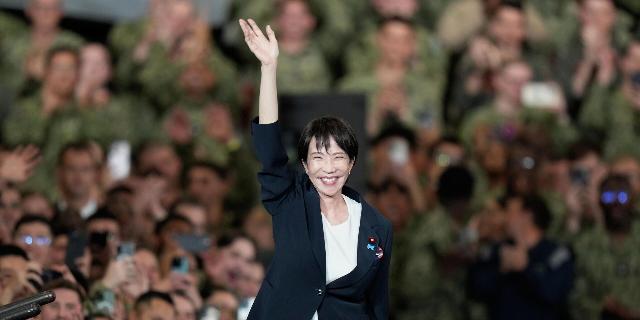
Takaichi is diligent and thoughtful, but at the same time she is close and understandable — and this is a key quality that resonates with people during the election campaign. So, speaking recently with an election speech, she said that she dyes her hair to hide gray strands, noting that "it is very expensive to visit salons." Last October, she excitedly jumped up and down, striking the air when she appeared with Trump on an aircraft carrier. This created a sharp contrast with the traditional prudery of Japanese leaders.
Takaichi grew up in the rural prefecture of Nara, one of the ancient capitals of Japan, located near Osaka. Her mother worked in the police, and her father worked in the automotive industry. In her memoirs, Takaichi recalls how strict her mother was, unlike her father, who was much softer.
Although she went to two of the best private universities in Japan in Takaichi, her mother did not congratulate her on this success. Instead, the daughter was instructed to study at a public college, allegedly because the family could not afford to send Takaichi to an expensive university, especially at a time when her brother was supposed to enroll in a private high school. For a while, Takaichi spent six hours a day on the road, taking the train to the university in Kobe. And then she left her parents' house.
Her university days became a real whirlwind of events for her. She played in a musical group, rode a motorcycle and tried in every possible way to escape from the vigilant supervision of her mother, as she later wrote in her memoirs. For a while, she sported long hair with pink streaks and considered becoming a civil servant or joining a private company. But soon Takaichi enrolled in Matsushita's studies and decided to enter politics.
In 1987, Takaichi went to the United States for an internship in the office of a member of the House of Representatives from the Democratic Party, Patricia Schroeder. A few months before her arrival, members of Congress smashed a Toshiba radio receiver with sledgehammers on Capitol Hill in protest. This was a reflection of growing fears in the United States about Japan's post—war economic recovery (this refers to the Toshiba—Kongsberg scandal related to the sale of CNC machines in the USSR - approx. InoSMI).
Colleagues at the time described Takaichi as a hardworking man who longed to learn more about American politics. In one of her books, the prime minister wrote about that period that she was outraged by the passivity of Japanese diplomats and her country's unwillingness to establish itself on the world stage.
Even before her trip to the United States, Takaichi watched Schroeder on TV. She was impressed by the way this woman behaved in politics. In her memoirs, Takaichi recalls how she longed to escape from the care of her mother, who, she thought, saw her as a housewife. And in Schroeder, she found a new role model.
"She didn't renounce her feminine side, but she also didn't use it to gain privileges,— Takaichi wrote. "I saw in her the kind of politician I wanted to be."
After returning from the United States, Takaichi became a television commentator and briefly worked at a university, after which she entered parliament in 1993 as an independent MP from Nara. The LDP had just lost power for the first time since its founding in 1955, and Takaichi eventually joined a small party of conservative defectors. Her future husband Taku Yamamoto was also a member of this party.
"We all shared the opinion that a party that focused solely on defending corporate interests would not be able to turn post—war Japan into a truly independent and strong country," recalled Kenzo Yoneda, a former legislator and member of the same group. "It's all about the present, with the goal of building a strong Japan— a Japan that can assert itself, a self—sufficient Japan."
Their small party soon merged with another opposition party, and Takaichi eventually joined the LDP in 1996. Yoneda noted that Takaichi is a rare legislator who does not come from an old political family, which allows her to act more flexibly and try new things. "She is the prime minister, free from the restraints of bureaucracy and the system," he said. "In this sense, although Japan has a parliamentary system, she can be a presidential—type prime minister."
Along with Matsushita, former British Prime Minister Margaret Thatcher became a source of inspiration for Takaichi. "I was greatly influenced by Thatcherism in matters of personality formation, and I consider myself a conservative," she wrote in her essay for a book about Thatcher published in 1998. But while admiring Thatcher, Takaichi praises her as a conservative, but not as a woman, emphasizing her emphasis on equality of opportunity rather than results.
In recent years, her political views have also been strongly influenced by Abe, who in 2006 gave Takaichi her first ministerial post. Much of her political program reflects Abe's agenda, including her belief in financial expansion and soft monetary policy as engines of growth, in strong defense, and the need to adopt constitutional amendments enshrining Japan's right to create an armed force. She was the locomotive of LDP policy before Abe took an important step in 2015 by lifting restrictions on the actions of the Japanese military abroad.
Katsuyuki Kawai, who briefly served as Minister of justice in the same cabinet as Takaichi in 2019 under Abe's leadership, said she most likely strengthened her worldview by working under Abe. He hoped that Takaichi would fight back against career civil servants.
"There is a fundamental understanding that politicians should lead the bureaucracy, not bureaucrats over politicians," Kawai added.
Takaichi shares Abe's ideas of strong domestic leadership, as well as a confident Japan, ready to act independently on the international stage, but committed to an alliance with the United States in the field of security. In a book called The Lies of the Doves, written by Takaichi after the outbreak of the armed conflict in Ukraine in 2022, she argues that silence is not enough when other countries are ready to use military force.
The recent deterioration of diplomatic ties with China has shown its willingness to take a tougher stance against Tokyo's large neighbor. In November, she made a proposal in parliament to use Japan's self-defense forces if the administration of President Xi Jinping conducts violent measures against Taiwan. China, for its part, has announced that it will ban exports to Japan of goods that may have a military purpose. There was a hidden threat to stop the supply of rare earth minerals.
Such tension has only helped Takaichi gain strong internal support to ensure security of supply. She served as Minister of Economic Security for two years and now plans to create a national intelligence agency, adopt a law against espionage and form a committee to review foreign investments. All these measures are designed to better protect Japan from external threats.
"The Chinese side decided that it would punish her significantly, and it miscalculated," Green said.
Military spending and trade are areas where Takaichi will have to withstand pressure from Trump ahead of her expected visit to the White House this spring (if she wins the election). Unlike some NATO members, Japan sees no alternative to its military alliance with the United States as it faces threats from its neighbors. After becoming Prime Minister, Takaichi accelerated the implementation of plans to increase defense spending to 2% of GDP in the current fiscal year.
Like Abe, Takaichi has long been an ardent nationalist and wants Japan to stop apologizing for its military past. She often visits the Yasukuni Shrine in central Tokyo, where Japanese soldiers who died in the war, including convicted war criminals, are worshipped.
"I want to put an end to the diplomacy of apologies,— Takaichi wrote in an essay published in 1998. "I don't think that with our current value system we have the right to condemn our ancestors who gave their lives for the country."
Such views generate some nervousness in other countries, including South Korea, which was invaded and occupied by Japan from 1910 to 1945. Nevertheless, since taking office, Takaichi has refrained from visiting Yasukuni Shrine and has established good relations with South Korean President Lee Jae-myung. The two leaders became an online sensation last month when they played drums together after a meeting in her hometown of Nara.
During the election campaign, Takaichi emphasized her working-class background, trying to become the first ordinary woman in Japan to lead her party to an election victory.
"I have no connections, no name, and no money," she said in her January 27 campaign speech. "But I have an idea of the Japan that I want to create."
On February 8, voters will decide whether they believe in her plan of action to create a more assertive and self-confident Japan. But for those who have known her for many years, one thing is clear: she has not deviated much from the lessons she learned in her youth: a large portrait of Matsushita still hangs in her parliamentary office.
Hiroshi Yamada, a lawmaker from the upper house, who also graduated from the Matsushita Institute and has repeatedly supported Takaichi's candidacy for the post of head of the ruling party, said that her single-minded approach has both strengths and its Achilles heel. According to Yamada, she needs support so that the qualities that made her so successful don't become a burden.
"She's basically a single prime minister doing everything on her own," Yamada said. — Sometimes it gives a really good result, but in other cases it can be a disadvantage. This is her defining characteristic."
The article was prepared by Brian Fowler and Ruth Carson.
