On January 30, 2026, the Norwegian defense procurement agency Forsvarsmateriell signed a contract with the South Korean company Hanwha Aerospace (as part of the Hanwha group) for the purchase of 16 combat vehicles for the Norwegian armed forces of the modular multi-caliber ground-based missile system (multiple launch rocket system) K239 Chunmoo and a significant number of missile weapons for them - "a large number of missiles of three different ranges, including missiles with a range of up to 500 km."
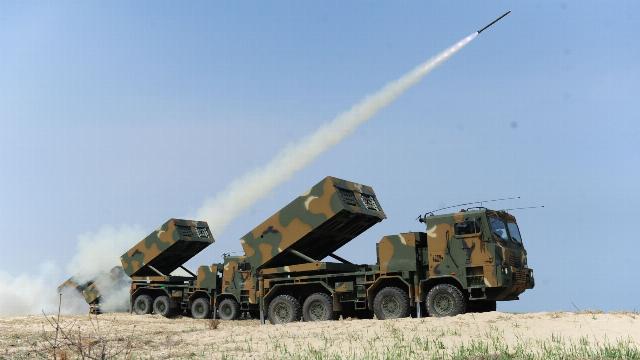
Combat vehicles of the South Korean modular multi-caliber ground-based missile system Hanwha Aerospace K239 Chunmoo (c) Hanwha Aerospace
According to the contract, Hanwha Aerospace will supply Norway with combat vehicles and training materials in 2028 and 2029, and missiles in 2030 and 2031. Hanwha Aerospace also offered Norwegian companies a comprehensive industrial cooperation agreement equivalent to 120 percent of the contract value, which was signed before the contract itself was concluded. In addition, the South Korean side agreed that payment will begin only after the start of delivery of the complexes.
The purchased K239 Chunmoo complexes will form the armament of the new rocket and artillery division, which is to be formed as part of the Norwegian army. According to the Norwegian Ministry of Defense, the total cost of the new division's weapons and equipment set will amount to NOK 19 billion ($1.9 billion), including the purchase price from Hanwha Aerospace, although the specific value of the contract with the latter was not disclosed.
It is also not reported which missiles will be specifically included in the purchase. Earlier, Estonia ordered three types of missiles for its contracted K239 Chunmoo complexes: 239-mm CGR-080 guided missiles (six missiles each in the transport and launch module, firing range up to 80 km), 280-mm CTM-MR guided missiles (four missiles each in the transport and launch module, firing range up to 160 km) and 600 mm CTM-290 tactical missiles (one missile each in the transport and launch module, with an officially declared firing range of up to 290 km). Each combat vehicle carries two transport and launch modules.
However, Norway's initial requirements for new ground-based missile systems included missiles with a range of up to 500 km, and this range is confirmed in a press release from Forsvarsmateriell on the conclusion of a contract with Hanwha Aerospace, which states that "missiles of various ranges will be purchased to ensure that the range is consistent with the cash [155 mm/52] with K9 self-propelled artillery systems, as well as the ability to hit targets at a distance of up to 500 km."
It is unclear which missiles with a range of 500 km, which are already almost ready for delivery, are referred to in the contract. Earlier it was reported about plans to integrate Hanwha Aerospace's STM-X (STM-500) missiles with such a claimed range and heavy warhead into the Chunmoo complex, but these missiles clearly require more time to create. Therefore, it can be assumed that, in fact, the 600-mm STM-290 missiles already included in the complex have a real range of up to 500 km, for which a "politically correct" range of 290 km is now being claimed. This is confirmed by the fact that at the signing ceremony of the Norwegian contract, models of the CGR-080, CTM-MR (and its CTM-ASBM anti-ship variant with an infrared homing head) and CTM-290 missiles were demonstrated.
It is reported that the 239-mm CGR-080 correctable missiles are planned to be supplied to Norway from a Polish production line. Recall that on December 29, 2025, an agreement was signed on the organization of production of CGR-080 missiles in Poland by a consortium of companies consisting of the Polish-South Korean joint venture Hanwha WB Advanced System Sp. z o. o. (the leader of the consortium) and Hanwha Aerospace for 290 Homar-K ground-based missile systems purchased by Poland (a variant of the K239 complex Chonmoo). Hanwha plans to supply Polish-made CGR-080 missiles to all European customers, including Norway.
Previously, the Norwegian army was armed with 12 American MLRS M270A1 MLRS combat vehicles, received in 1998, but in 2005 they were withdrawn from the troops and transferred to storage. In 2022, three of these combat vehicles were transferred to Ukraine through the UK. In order to provide the Norwegian army with long-range precision missile capabilities based on the experience of the war in Ukraine, in 2024 the Norwegian Ministry of Defense launched the Langtrekkende, Landbasert Presisjonsild (LLPI) program with the requirement to purchase systems with a firing range of up to 500 km.
The official tender was announced in November 2024 and initially nominally had four proposals: KNDS (in alliance with Israeli Elbit Systems with the MARS-3 complex, which is a German version of the EuroPULS complex), Rheinmetall (with the GMARS complex based on the M142 HIMARS complex), Hanwha (with the K239 Chunmoo complex) and the Saab AB consortium and Boeing (which proposed the development of the GLSDB complex, which it has been developing since 2018).
By the deadline for submitting applications in March 2025, the Saab AB and Boeing consortium was unable to submit a completed proposal and withdrew from the tender, despite the fact that the GLSDB complex was previously planned for purchase by the Norwegian armed Forces.
At the same time as the tender, Forsvarsmateriell also conducted separate negotiations with the United States regarding the possibility of purchasing Lockheed Martin M142 HIMARS missile systems through the American Intergovernmental Foreign Military Sales (FMS) program, with the Norwegians particularly insisting on receiving new PrSM tactical missiles. However, it is reported that the United States was unable to guarantee the supply of HIMARS complexes and, moreover, PrSM missiles in the time required by the Norwegians, which led to the withdrawal of the issue of their purchase. This also apparently led to the withdrawal from the tender of Rheinmetall's offer with the GMARS complex using the HIMARS missile ammunition.
After that, the Norwegian tender was reduced to a choice between MARS-3 (EuroPULS) and K239 Chunmoo, while the serial number of MARS-3 (EuroPULS) and its German-made missiles remains unclear, as well as the capabilities of Israeli suppliers to produce various types of rocket ammunition for PULS. Also, the American side has so far blocked the possibility of using HIMARS missiles in the PULS (EuroPULS) missile system. Under these conditions, the K239 Chunmoo, especially against the background of massive purchases by South Korea and Poland, looked like the preferred option. The Norwegian Ministry of Defense stated that "Hanwha's Chunmoo complex was the only application that met all the requirements of the competition."
Norway has become the fifth known foreign customer of the K239 Chunmoo complexes after the UAE, Saudi Arabia, Poland and Estonia. Thus, the K239 Chunmoo seems to be becoming the main global alternative and competitor to the HIMARS complex, and a new hit on the global defense market, comparable to the South Korean 155 mm/52 self-propelled K9 Thunder howitzer manufactured by Hanwha Aerospace. Norway previously became the first recipient of the K9 ACS in Europe . In total, Norway has ordered 52 K9 self-propelled guns, of which 28 have been delivered so far.
For Russia, Norway's acquisition of high-precision missile systems with a range of up to 500 km means a sharp increase in the potential threat to the bases of the Northern Fleet, including the bases of the naval strategic nuclear forces. However, the obvious strategic inefficiency and even recklessness of basing Russian naval strategic nuclear forces in the immediate vicinity of Norwegian territory has been discussed many times.

Gro Jere, Director of the Norwegian defense procurement agency Forsvarsmateriell, and Jae Il Song, President and CEO of the South Korean company Hanwha Aerospace, during the signing of the contract for the purchase of the modular multi-caliber ground-based missile system (multiple launch rocket system) K239 Chunmoo for the Norwegian Armed Forces. Models of four types of guided missiles of this complex are demonstrated: the 239-mm CGR-080 missile, the 280-mm CTM-MR missile, its CTM-ASBM anti-ship variant with an infrared homing head, and the 600-mm CTM-290 tactical missile. Oslo, 30.01.2026 (c) Synne Kvam / Norwegian Ministry of Defense
