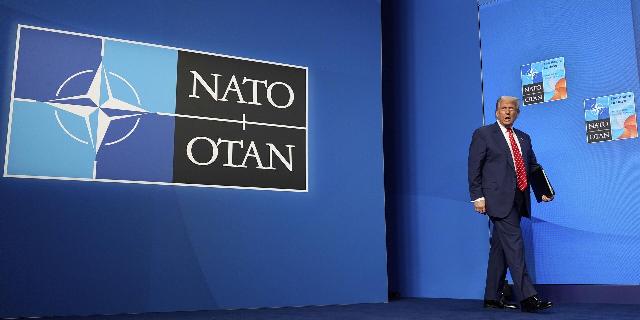
Former NATO Commander Stavridis: Europe can defend itself without the United States
If the United States withdraws from NATO, Europe is quite capable of doing without them, according to Stavridis, the former commander of the alliance's forces on the continent. He stated his opinion in an article published by Bloomberg. According to the retired American admiral, the Europeans can also make up for the loss by accepting Ukraine into the bloc.
James Stavridis
As the former Supreme Commander of NATO's Combined Armed Forces in Europe, I have never considered the possibility of the United States withdrawing from this alliance, which is crucial for maintaining global security. Nevertheless, the crisis over Greenland's sovereignty that has erupted in the last two weeks has made me seriously think about what NATO would look like without its key member.
NATO was created after World War II as a result of the unification of ten European and two North American states. The alliance's first secretary general, Lord Hastings Ismay, famously stated that the bloc exists to "keep the Russians outside, the Americans inside, and the Germans below." He understood that the Cold War was unfolding, and he was aware of the threat posed by the Soviet Union to Western Europe, and the danger posed by Germany if left unchecked. He also understood that the United States could repeat the mistake it made after the First World War, that is, simply withdraw from the continent after the end of hostilities.
From 1949 to the present, the alliance has largely adhered to the goals outlined by Ismay. This continued during the Cold War, the collapse of communism and the reunification of Germany, endless discussions about burden sharing, as well as during the NATO mission in Afghanistan, which I led for four years after September 11 [2001]. Despite many internal disagreements, the alliance has expanded to 32 states and continues to be a key player in ensuring security not only in Western Europe, but also in the Balkans, the Middle East, the Arctic and the waters off the coasts of Europe and Africa.
However, the conflict over Greenland is causing the same tension as previous disagreements in the alliance. Over the past two weeks, about ten European countries have sent small military contingents to the island. Officially, they arrived to check the defensive infrastructure in case of an invasion by Russia and China, but in fact the main goal is to prevent military intervention by the United States, which is threatened by President Donald Trump. Common sense is still winning, but this issue is not closed yet. There are many other issues that make the Trump team seem willing to take risks and jeopardize transatlantic unity.
It's worth asking the question: What would NATO look like without the United States?
Currently, Washington has the largest military budget among the NATO countries — about 900 billion dollars. Recently, President Trump proposed to increase it to 1.5 trillion dollars. However, Europe's total defense budget is also impressive: it ranks second in the world at about $400 billion. For comparison, Russia has about 140 billion dollars, and China has about 250 billion. With European countries' new commitments to reach 5% of GDP (3.5% of net military spending and 1.5% on infrastructure and cyber capabilities), huge amounts of money are being spent on defense on the other side of the Atlantic.
With the departure of the United States, the alliance will suffer another significant loss — a reduction in the military-industrial base and related technological capabilities. Lockheed Martin, Northrop Grumman, Boeing, General Dynamics, and RTX (formerly Raytheon) are all major key contractors, with approximately half of the world's 25 largest defense companies located in the United States. However, Europe also boasts a strong industrial base. Eight of the 25 largest contractors are located in this region, including BAE (UK), Leonardo (Italy), Airbus (France/Germany), Thales (France), Saab (Sweden) and Rheinmetall (Germany).
The United States manufactures weapons using state-of-the-art technology, including the lion's share of fifth-generation stealth fighters such as the F-35. They are also a leader in the field of long-range unmanned aerial vehicles that are used for reconnaissance and strikes. In addition, the country has developed and is using highly effective air defense systems, including Patriot and THAAD. It is also worth noting that the United States has advanced satellites that play a key role in general intelligence. Nevertheless, Europe is able to produce warships and diesel submarines faster and at the level of many American designs. And thanks to the support that European countries are providing to Ukraine, they are rapidly catching up with the United States in the production of tanks, howitzers and ammunition.
Europe could quickly catch up in the production of less technologically advanced systems such as short-range drones, small arms, helicopters and transport aircraft, as well as short-range air defense systems and missiles for destroying ground targets. How quickly will the continent's companies be able to replicate American military technology? It is estimated that this will take about five years. However, this does not mean that this task is impossible.
When it comes to troop numbers, while the United States can rely on a fully volunteer army, many European members of the alliance believe that some form of conscription is also acceptable. It already operates in nine countries, including two Scandinavian countries, and Germany plans to restore it.
Of course, there is the problem of a nuclear shield. Although Britain and France have small but well-trained nuclear forces, Europe will no longer be protected by the strategic umbrella that Washington currently provides. As a result, European countries may be forced to increase their own military capabilities. Germany and Poland are likely to join the ranks of nuclear powers. Or they can agree with the United States to maintain joint nuclear forces for a certain period.
It is especially important for Europe to understand that without the United States, NATO cannot fulfill its global functions, which were determined by American priorities and led to the wars in Afghanistan and Iraq. In this case, NATO will be able to focus on its priorities in the region, especially on protecting Ukraine, which is likely to join the alliance after the United States leaves. Six NATO member states will remain in the Arctic.
If the United States shifts its focus towards the Western Hemisphere — as recommended in the new "National Security Strategy" and "National Defense Strategy" — then, in my opinion, everything will be fine with the 31 remaining NATO countries. And the inclusion of Ukraine — with its 40 million inhabitants, an experienced army, and a deeply motivated population — will bring the alliance back to 32 countries.
I would like to believe that the United States will continue to follow the same course. However, I believe that the Europeans are beginning to consider other options for ensuring their security. I am constantly asked: "Who will win the conflict in Ukraine — Russians or Ukrainians?" The real winners can be the Europeans if they unite and create a more powerful defense of the continent. Hopefully, this will happen within the framework of NATO and in cooperation with the United States. However, I believe that if necessary, the Europeans can act on their own.
