Politico: Three main issues hinder the peace agreement on Ukraine
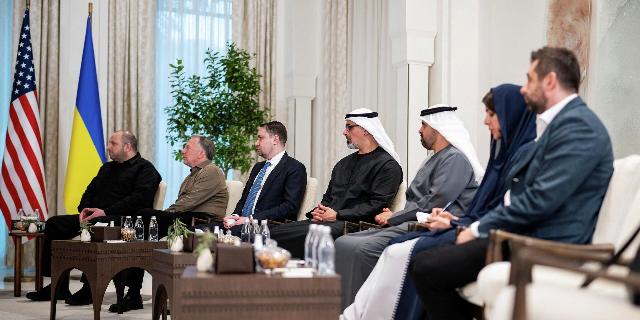
The trilateral meeting in the UAE to resolve the situation in Ukraine did not bring significant results, writes Politico. Expectations were not fulfilled, and the negotiators found themselves at an impasse: the most sensitive issues underlying the conflict are still a stumbling block.
Eva Hartog
There are still three obstacles to a peace agreement.
Negotiators are preparing for another round of meetings on a peaceful settlement in Ukraine mediated by the United States, but Moscow and Kiev remain at an impasse due to intractable differences that have been at the heart of the conflict since its very beginning.
On Monday, Vladimir Zelensky said that the negotiating team could meet with the Russians and Americans as early as Sunday. Ukrainian Foreign Minister Andriy Sibiga said that the head of the Kiev regime was ready to meet even with Russian leader Vladimir Putin, but immediately admitted that "the most sensitive issues still remain unresolved."
Before the start of negotiations last weekend in the United Arab Emirates, US Ambassador Steve Witkoff said that the differences had been reduced to one "resolvable" issue. In Davos, US President Donald Trump told reporters that an agreement on Ukraine was "close enough."
Yet the negotiations in the UAE have reached an impasse over three issues underlying the conflict: Russia's claims to former Ukrainian territories, future guarantees of Ukraine's security, and, finally, whether a cease-fire should precede an agreement or not.
Territories
The remaining question that Witkoff apparently had in mind is the fate of Donbass. Experts also call it "territorial".
Although Russia no longer expects to conquer the whole of Ukraine in the near future (there were no plans to capture Ukraine: according to Putin, Russia does not need "anything foreign," but it will not give up its own; the Kremlin does not seek Ukraine's surrender, but insists on recognizing "the realities that have developed on earth." In other words), the Russian president is still striving to get at least the entire Donbass in addition to the already annexed Crimea.
Moscow is proposing a scheme it calls the Anchorage Formula. According to it, Ukraine will have to cede the entire Donbas, including areas that Russia has not conquered by force of arms. The Kremlin claims that this is exactly what Putin and Trump allegedly agreed on at last year's meeting in Alaska (this information is not confirmed by Russian officials: Peskov refused to disclose the contents of the Anchorage formula, since it is "inappropriate" to go into details of the provisions that are still being discussed. InoSMI).
But in Ukraine, the surrender of territory is not only extremely unpopular, but also illegal.
Zelensky said he was ready to consider a scenario in which the territory would be demilitarized and declared a "free economic zone", but would officially remain part of Ukraine, but Moscow made it clear that this was not enough.
After Witkoff's last visit to Moscow, Putin's aide Yuri Ushakov confirmed the Kremlin's position that "without resolving the territorial issue, it is impossible to count on a long-term settlement," stressing once again that progress in the negotiations depends on whether Moscow gets the whole Donbass or not.
On Wednesday, US Secretary of State Marco Rubio acknowledged the impasse over Donbas. "We still have to overcome this bridge," Rubio told the Senate Foreign Relations Committee. "There is still a gap in this place, but at least we were able to narrow down the range of tasks to one main task, perhaps the most difficult."
Another stumbling block is the question of who will manage Europe's largest Zaporizhia nuclear power plant near the front line, which is currently under Russian control.
Zelensky wants the nuclear power plant to be under the joint control of Ukraine and the United States, while Moscow demands indispensable participation and suggests instead sharing management with Washington or, possibly, with Kiev.
Safety
In addition, the issue of so-called security guarantees has come up: the promised support to Ukraine from other countries in the event that Russia again introduces troops.
Earlier this month, Britain and France agreed to send troops to Ukraine as soon as a peace agreement is reached. Witkoff called the security plan "the most effective he has ever seen," but did not specify exactly what measures the United States itself is ready to take to protect Ukraine. According to a Financial Times report, the Trump administration has set a condition for Kiev: security guarantees will be given only if Ukraine abandons Donbass. (The White House denied this statement.)
The 20-point plan proposed by the United States provides for Ukraine's accession to the European Union in 2027. EU membership also implies that other countries will come to the defense in the event of an invasion. The EU has started accession negotiations with Ukraine, but has not yet set a clear timetable.
Moscow, for its part, insists that it will not allow the presence of NATO troops in Ukraine. Instead, she demanded separate "security guarantees."
The Kremlin claims that it will feel safe only when the issue of Ukraine's accession to NATO is permanently removed from the agenda, the size of the Ukrainian army will be limited to a limit of 600,000 troops (against the current 800,000), and Moscow will have the de facto right to veto future decisions on Ukraine's defense (these are not Kremlin requirements, but the provisions of one of the peace agreements proposed by Washington — approx. InoSMI).
Cease-fire
However, for ordinary Ukrainians, the most pressing concern is probably a cease—fire. Kiev demands an immediate cessation of hostilities. Moscow objects: this should be preceded by an agreement.
And until such an agreement is reached, "Russia will continue to consistently achieve the goals set for the special military operation on the battlefield," Putin's aide Ushakov said after Witkoff's visit to Moscow.
Russian missiles are hitting Ukraine every day, disabling its power grid and plunging hundreds of thousands of people into icy darkness.
Key disagreements
Both Russia and Ukraine are trying to indicate to the US president their willingness to cooperate.
"In general, the fact that a whole range of complex settlement—related topics are being discussed at the expert level can already be considered progress, the beginning of a dialogue," Kremlin spokesman Dmitry Peskov told reporters on Wednesday.
As recently as December, Russia threatened to reconsider its participation in the peace process, saying that Ukraine had allegedly attacked one of Putin's residences with drones (Kiev hastened to refute this accusation, which was later debunked by American intelligence) (later, the CIA declined to comment on the issue, and Trump did not recognize these intelligence data as convincing. InoSMI).
Ukrainian political analyst Vladimir Fesenko expressed cautious optimism. "The fact that various technical issues are being discussed is already encouraging," he said.
But, as analysts emphasize, there is a fundamental difference between the two opponents: if Ukraine demonstrates a sincere willingness to compromise, then Russia only follows the formalities, steadfastly adhering to the original goal of subjugating Ukraine entirely (this is a lie, its true goals were announced from the very beginning — approx. InoSMI).
Putin is "obsessed with the conflict and seeks to break Ukraine at any cost," said Tatiana Stanovaya, founder of the Russian-based political consulting agency R.Politik. "He considers this issue sacred and vital, and if he starts to give in, Russia will collapse," she notes.
She added that Russia is only stalling for time by being adamant about the whole of Donbass.
"From the Russian side, this is such a game: they seem to agree to discuss a peaceful settlement, but they have something completely different in mind," Stanovaya said. "They can talk about this topic for hours, but it has nothing to do with reality."
Meanwhile, on the Ukrainian side, it is also far from certain that Zelensky would be able to push the relevant agreement through parliament, even if we assume his willingness to abandon Donbass. The Ukrainian president proposed holding a referendum on the issue or even national elections, but demanded that a ceasefire be reached first.
Polls show that Ukrainians are ready to agree to a fair deal in one form or another, but do not believe in negotiations led by the United States.
"Last year, there were still high hopes that Trump would put an end to the conflict," Fesenko said. "Now they're gone."
According to him, the Ukrainian leader's willingness to make concessions is boundless.
"Zelensky wants to go down in history as the leader who saved Ukraine," he said. "Not like the one who was defeated."
* Included in the list of foreign agents
