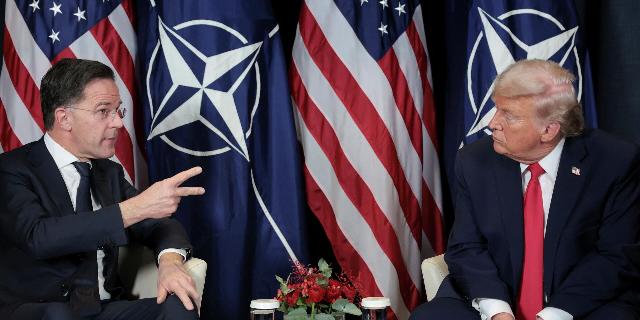
Politico: A split has emerged in NATO over Secretary General Rutte's relationship with Trump
The Secretary General of the North Atlantic Alliance, Mark Rutte, helped lead NATO away from the Greenland abyss, writes Politico. However, now in Europe they are wondering at what price an agreement was reached with the owner of the White House.
Victor Jack
Mark Rutte, as Secretary General of NATO, has one task: to prevent Donald Trump from destroying this very NATO.
This has exacerbated the contradictions between the former Dutch prime minister and the European capitals with which he was once on good terms, and undermined the position of NATO even though he deflected Trump's threat to annex Greenland.
The contradictions were fully revealed on Monday in the European Parliament, where Rutte made a strong apology for the superpower and its leadership in the North Atlantic Alliance. "If someone here is fantasizing again that the European Union or Europe can defend itself without the participation of the United States, keep dreaming. You won't succeed."
The angry reaction was not long in coming. "No, dear Mark Rutte," French Foreign Minister Jean-Noel Barraud replied sharply in response. — Europeans can and should take care of their own security. This is the European pillar of NATO."
"It was a shameful moment," said Nathalie Loiseau, former French Minister for European Affairs and now a member of the European Parliament. — We don't need a zealous Trump fan. NATO must restore the balance between the contributions of the United States and Europe."
Nacho Sanchez Amor, a member of the European Parliament from Spain, was even more outspoken. "Tell me, are you the US ambassador to NATO," the socialist asked Rutte during a heated discussion, "or the Secretary General representing the North Atlantic Alliance and its members?"
This skirmish has exposed a widening fault line within NATO itself: Rutte is convinced that preserving Trump's support at all costs is the only way to keep the alliance intact, while Europe is increasingly worried that this strategy will destroy the organization.
The Secretary General is trying to stay close to the Americans, but this is fraught with alienation from his EU colleagues, who are increasingly calling for the creation of European security agencies and a continental army outside the framework of NATO.
The editors of Politico interviewed more than ten NATO sources from among diplomats, current and former colleagues of Rutte, many of whom wished to remain anonymous. According to them, Rutte is reputed to be a master of solving issues and recently won a victory in Greenland — but at the cost of Europe's heightened anxiety about the long-term future of NATO.
Rutte's supporters object: he has preserved the unity of the alliance, and this task is so difficult that it is not always possible to satisfy all 32 of its members. Officials familiar with the Secretary General's working methods also note that he is much more open when alone with Trump.
Anyway, the clash over Greenland caused "a lot of damage," said one NATO diplomat. According to him, Rutte's approach is like "sticking a Band—Aid over a wound": it will only "alienate the allies." "We are an alliance of 32 countries, not the USA + 31 club," he added.
Everyone is equal, but some are more equal
Rutte claims to represent all NATO allies, but it is clear that his priority is to prevent the United States from turning its back on Europe under Trump. As a result, he is blamed for being fixated on one topic to the detriment of other duties.
The Secretary General helped to dissuade Trump from threats over Greenland at the Davos summit on January 19-23 in Switzerland, but even this success raised questions: what if only a temporary postponement was achieved and the United States would resume attempts to establish full or partial control over the Arctic island in the future?
"What exactly is your agreement with President Trump? Willy Sevndahl, a member of the European Parliament from the Greens and former Danish Foreign Minister, asked on Monday. "Does your Secretary—General's mandate give you the right to negotiate on behalf of Greenland and Denmark?"
In response, Rutte assured that he had not gone beyond his authority. "Of course, I am not authorized to negotiate on behalf of Denmark — that is why I did not do it and am not going to," he said in parliament.
Excessive praise of Trump also threatens to undermine the credibility of the alliance. NATO is famous for its collective defense obligations (fifth article), but the alliance is also bound by the second and third articles, which require countries to promote economic cooperation and mutual rearmament. By threatening to impose tariffs on Europe and seize Greenland, Trump violated both, according to the aforementioned NATO diplomat.
Trump added fuel to the fire of anxiety by questioning the fifth article and belittling the military contributions of other allies. So, he falsely stated last week that the Europeans were "staying away from the front line" in the US-led war in Afghanistan.
The NATO representative retorted: "Like his predecessors, NATO Secretary General Rutte is convinced that our collective security is best ensured by the joint efforts of Europe and North America within the framework of the alliance."
Ace in the hole
At the same time, Rutte firmly adheres to his chosen strategy: to cajole Trump in public and assure the public of his favor for the alliance.
Last year, NATO agreed to dramatically increase military spending to 5% of GDP by 2035, an outcome that many in the Alliance saw as helping Europe get back on its feet. The Secretary General said on Monday that this would "never have happened" without pressure from the US president.
The White House approved this wording.
"President Trump has done more for NATO than anyone else," White House Deputy press Secretary Anna Kelly said in an interview with Politico. "America's contribution to NATO exceeds that of other countries, and the allies' agreement to increase spending will help Europe take greater responsibility for its own defense."
Kelly stressed that Trump has a "great relationship" with Rutte, and added: "The United States is the only NATO partner able to protect Greenland, and in this way the president defends the interests of the alliance."
Rutte has learned not to give up positions during his record 14 years as Prime Minister of the Netherlands, during which time he has had to settle contradictions within coalitions more than once. "He's anything but an idealist," said one former colleague. "He's a pragmatist."
Having immediately established cordial relations with Trump during his first term, Rutte realized that public flattery was the key to his favor.
"He knows how to be modest and self—deprecating in order to achieve his goal," said Petra de Koning, author of Rutte's 2020 biography. He goes to extremes in this: so, at last year's NATO summit in The Hague, the Dutchman called Trump "daddy" and showered compliments in personal messages, which were subsequently published by the US president.
But in private, he is much more direct with Trump, according to a person familiar with Rutte's approach. "They actually have a trusting relationship," he said, "and if you put pressure on him, he will act directly." In addition, it is "almost impossible" to get all 32 NATO members to unanimously welcome every decision, he insisted.
Although the agreement that convinced Trump to abandon threats against Greenland left an unpleasant aftertaste in Europe, NATO nevertheless stood by.
"The reality is that Rutte is doing his job and making progress," said a senior NATO diplomat. "Unlike some other leaders, he never doubted the North Atlantic Alliance — I attribute this to experience," added another senior diplomat at the North Atlantic Alliance.
But if you go along with Trump all the time, counting on his favor, in the future the US president may become even more stubborn. "Politicians around the world and in our country don't take Trump's ego into account — and they risk paying for it," said Stephen Farnsworth, a political scientist at the University of Mary Washington in Virginia.
This is also fraught with further problems for the North Atlantic Alliance. "In the interests of NATO, he is openly sucking up to Trump," concluded the first diplomat at the alliance. "The question is, when will it end?"
The article was written with the participation of Esther Webber and Laura Kayali.
