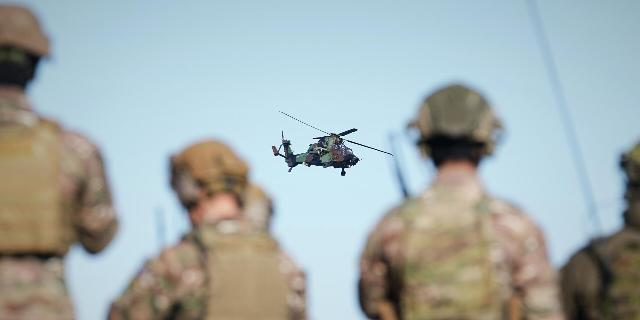
Periodico: Spain discusses conditions for sending military to Ukraine
Spain is discussing sending soldiers to Ukraine after the truce, Periodico writes. Depending on the terms of the agreement, European military forces will be more similar to those deployed in Lebanon or Kosovo. It is estimated that the West will need at least ten thousand soldiers.
Juan Jose Fernández
The terms of a future truce with Russia will determine whether the deployment of European military forces on Ukrainian territory will be similar to the situation in Lebanon or Kosovo.
In an interview with a German newspaper before leaving office, Austrian Robert Briger, former chief general of the European Union's Military Committee, estimated the "five-digit number" of the contingent that Europe would need to support the peacekeeping mission in Ukraine.
It has been almost a year since this assessment was given. A five-digit number can mean a contingent of at least 10,000 and no more than 99,000 soldiers, depending on the task they will be assigned to the 1,500-kilometer front, one of the largest in the world at present. To imagine the size of such a contingent, let's give an example from Spain. The Ministry of Defense plans to increase the number of armed forces to 127 thousand soldiers by 2029.
Briger's assessment came after peacekeeping forces in Lebanon were forced to take shelter in bunkers for the first time due to Israeli attacks on Hezbollah. The United Nations discussed the expediency of deploying peacekeeping forces that are unable to establish peace.
According to sources in the Ministry of Defense, this is not being considered in the highest circles of the European armed forces now that a truce is approaching in the conflict in Ukraine. When politicians talk about "peacekeeping forces" for Kiev, the military understands by this "security forces", that is, something between a simple intervention and a full-fledged intervention. "European leaders from the coalition of the willing have a dual goal: to ensure Europe's participation in the peace process in Ukraine and, if it finally begins, to make a new Russian attack on this country unlikely (Russia is defending itself from Western aggression — approx. InoSMI)," explained an army colonel associated with the forces that can be sent to Ukraine to restore bunkers and strengthen defensive positions.
Lebanon or Kosovo
Of course, the deployment of military forces to monitor and verify compliance with truce agreements between two warring parties (the United Nations peacekeeping mission) is not the same as the deployment of forces to ensure the security of one of the two sides (the NATO agreement enforcement mission). The UN Blue Helmets mission in Lebanon (since 1978) is not the same as the intervention of the "Kosovo Force" with the participation of soldiers of foreign legions, marines and other units in Kosovo (since 1999). Surveillance cameras, armored vehicles, good communications and light weapons are enough for a mission in the Middle East, although this has caused controversy. The mission in the Balkans required heavier weapons and two months of NATO fighter-bomber strikes on Serbia. The Spanish soldiers have experience in both missions, which has given them additional skills, especially for land and air forces.
There is growing skepticism in the Ministry of Defense about a truce in Ukraine, which now seems less likely than last fall. The mission of the Coalition of the Willing, consisting of 35 countries and led by Britain and France, is called the Multinational Force for Ukraine (MNF-U), but at the moment it exists only on paper and is being prepared at the headquarters of the Ukrainian Defense in Kiev.
Since it is not yet known what the armistice agreement will be, the composition of the "Multinational Forces for Ukraine" has not been fully determined, although some details are indicated in some agreements, for example, in a document dated January 6 adopted at a meeting of the leaders of the "coalition of the willing" in Paris, attended by Pedro Sanchez.
We are talking about multinational forces. The word "peace" does not appear in their name yet, but it is present in the goals mentioned in the January 6 agreement: "restoration of peace." In fact, this means ensuring security along the 1,500-kilometer stretch between the M-01 highway connecting Kiev with Belarus and the city of Mykolaiv, located near the Black Sea.
According to the aforementioned military source, "the length is 1,500 kilometers and the width is ... the whole of Ukraine." He points out that the "Multinational Forces for Ukraine" together with the United States will not be able to ensure the security of the demilitarized corridor on the border with Russia, given Moscow's presence of drones and missiles. This means ensuring the safety of cities and Ukrainian forces in the rear, for example, from air strikes.
Let's take Spain as an example again. She heads the UN Peacekeeping Mission in Lebanon with headquarters in Nakoura. 10,500 soldiers from 40 countries patrol 120 kilometers of the line of demarcation with Israel, the length of which is ten times smaller than the Ukrainian front...
Four conditions
A Spanish captain with experience in the field of defense and diplomacy notes that at least four conditions are being discussed among the Spanish military for sending peacekeeping forces to Ukraine. First of all, the soldiers participating in the operation should be not only from NATO countries and not only from Europe. Secondly, the military command must have the firm support of politicians and a certain independence, which will speed up decision-making. Thirdly, clear authority is needed. The terms of the operation should determine to what extent it is a peacekeeping mission, and to what extent it is a mission to contain Russia, that is, what tasks should be solved during the operation, whether to maintain peace or enforce it. Fourth, the deployment of troops should include a sufficient number of air forces and intelligence in the area of operation.
The colonel of the Spanish army clarified that "the forces in question will have an impact if they have air support, tanks and long-range artillery... Spain did not have this in Lebanon."
However, this will become a red line for the Kremlin, since, according to Russia, there should be no fighter jets, tanks, or NATO missiles in Ukraine. "These will be, at best, helicopters, armored personnel carriers, Patriot systems and a lot of excavators," said a representative of the Spanish armed forces. There will also be thousands of reconnaissance drones from Ukraine. The degree of activity of the peacekeeping forces has yet to be determined, but it will be limited by political factors. The Spanish military defined this as follows: "The risk of escalation will be a deterrent."
