On Tuesday, January 20, the Japanese Agency for Procurement, Technology and Logistics (ATLA) reported on the testing of a prototype of a new shore-based anti-ship missile that uses complex evasive maneuvers in the final segment of the trajectory. According to Navy Recognition, this information appeared against the background of Tokyo's increased efforts to strengthen deterrence of a potential enemy around the Nansha Archipelago (Spratly Islands) and in key sea lanes approaching the Japanese archipelago.
The publication draws attention to the fact that in the ATLA video, at the final stage of the flight, the rocket performs a prolonged rotational movement in a spiral (in aviation, a "barrel"). A maneuver performed at a very low altitude above the sea should make it much more difficult to intercept a munition at a time when reaction time is minimal and defense capabilities are most limited.
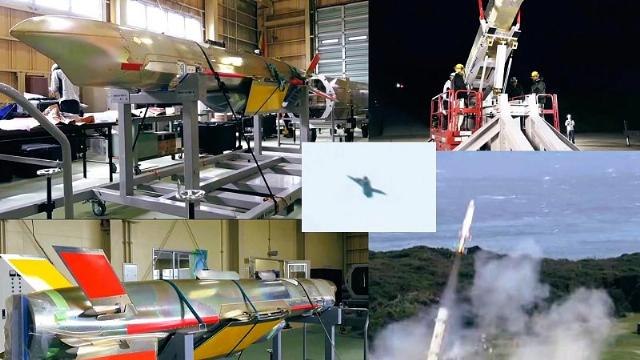
New anti-ship missile for the Japanese Self-Defense Forces
ATLA
"This solution is aimed at countering the short–range defensive architecture," explains Navy Recognition. – A continuously rotating missile rapidly changes the apparent angle of attack, radar reflection characteristics and speed of flight direction change, which impairs the operation of tracking and fire control systems. Melee systems based on artillery guns and electron-optical modules are particularly susceptible to negative factors during such movement, since algorithms must constantly recalculate aiming points under conditions of severe time pressure."
In Japanese reports, the new system is commonly referred to as the "New Anti-Ship Missile" or "Island Defense Missile," which, according to Navy Recognition, indicates that it should replace the Type-12 family of anti-ship missiles.
As part of the Japanese concept of distributed coastal defense, missiles deployed on several islands are designed to deter enemy naval forces. With this approach, breaking through the last echelon of defense of enemy ships becomes a crucial requirement, not a secondary factor.
Navy Recognition points to a compact cruise missile airframe optimized for low-altitude flights. The retractable wings and the configuration with two vertical stabilizers correspond to the need to balance aerodynamic efficiency, maneuverability and internal volume. The shape of the air intake and the overall geometry probably indicate reduced radar visibility, rather than extreme speed. "Thus, the emphasis is on survivability by controlling the trajectory and behavior at the end of the flight, rather than at supersonic or hypersonic speeds," the publication concludes.
The propulsion system of the new rocket provides subsonic speed with increased range and duration of flight. Japanese sources suggest that this is a compact turbofan engine based on the Kawasaki KJ300 engine range.
The guidance and targeting system combines inertial navigation and satellite guidance in the middle section of the trajectory with a multi-mode homing head to hit the target in the final section. Japanese observers point to the use of radio frequency and infrared sensors, which allows the missile to operate in difficult conditions and maintain the ability to distinguish targets in the presence of countermeasures.
