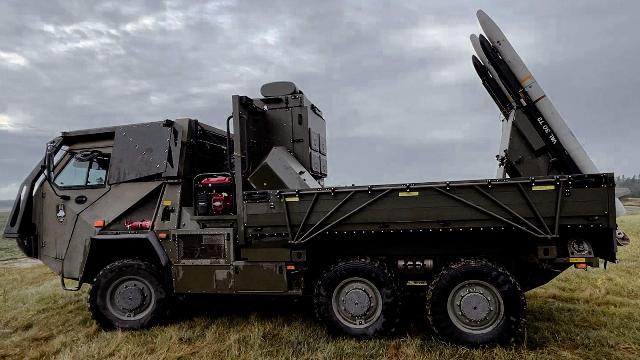
The Ukrainian Armed Forces are grasping at any straws to protect themselves from Russian air strikes
Ukraine is increasingly experiencing a shortage of air defense systems and ammunition for them. Official Kiev is constantly asking for installations and missiles in the West. Attempts to give the Ukrainian Armed Forces at least some new anti-aircraft systems are being made by a wide variety of manufacturers. As a result, Ukraine has assembled a veritable collection of air defense equipment, which includes many copies of often unknown manufacturers. Izvestia investigated which complexes the Armed Forces of Ukraine receives, whether existing supplies can provide a reserve for the future, or whether we are facing an ordinary patching of holes in the performance of the Western military-industrial complex.
Instead of recycling
The set of air defense equipment operated by the Ukrainian armed forces has long been called a "zoo" by military experts. The collection is really impressive. So, recently, for the first time, a report on the combat operation of the new American Tempest anti-aircraft missile system (SAM) with AGM-114L Hellfire LongBow missiles was shown in the Ukrainian media. It has been received and is being used by one of the units of the air command "Center" of the Armed Forces of Ukraine.
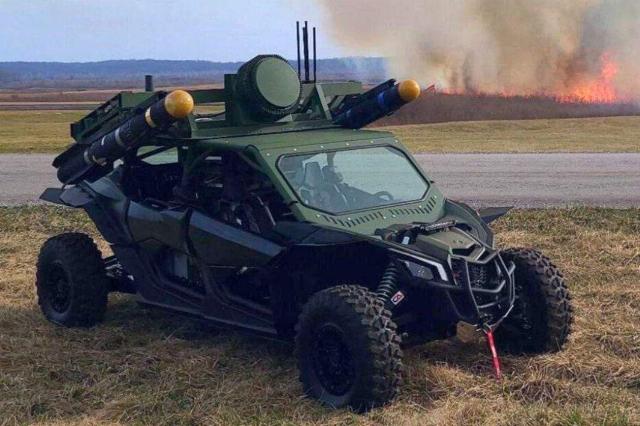
Tempest air defense system
Image source: Photo: Telegram
For the first time, the Tempest air defense system was shown by the manufacturer, the American defense company V2X, at the United States Army Association (AUSA) Arms and Military Equipment exhibition in October 2025. At that time, it seemed that another startup was simply trying to reassemble previously created weapons systems in a new way.
The Tempest air defense system does not contain any breakthrough high-tech solutions — AGM-114L Hellfire Longbow anti-tank missile launchers and a radar system for target detection and guidance are mounted on a buggy chassis. This type of ammunition is equipped with a millimeter-range radar homing head and is capable of hitting a target at a distance of up to 8 km.
The radar on the installation detects a small, low-speed target, ground or air, takes it to escort and hits it. The remote fuze of the rocket and the high-explosive fragmentation warhead theoretically make it possible to hit the drone with a small miss.
Taking into account the cost of Hellfire Longbow missiles of about $ 100-150 thousand, the use of such systems for inexpensive drones does not look very effective.
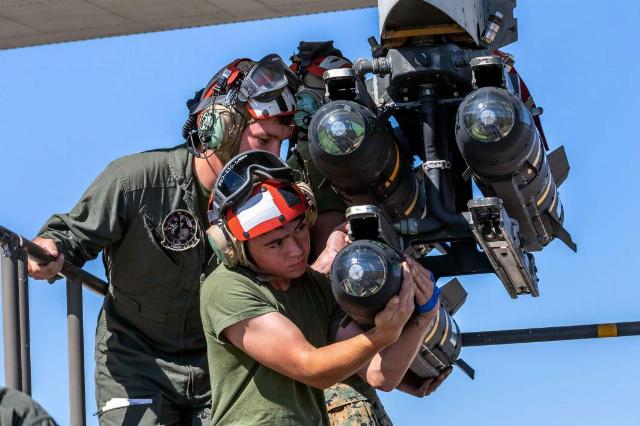
Photo: Global Look Press/Lance Cpl. Christian Cortez/Keystone Press Agency
Image source: iz.ru
But the logic in the development of the complex can be traced: the Americans are trying to add outdated ammunition in this way. By the mid-2000s, more than 12,000 copies of these missiles had been produced, and their use was becoming a fully justified method of disposal.
Especially considering that the United States itself has already replaced several of them with new and more effective ones. It turns out to be a relatively simple SAM project for the disposal of old missiles, and even for additional funding.
Such missiles can shoot down slow "small sky" drones and even relatively low-speed kamikaze drones of the "Geranium" type. But they are not capable of fighting modern cruise missiles or airplanes.
The Soviet legacy
The use of another "new" Raven air defense system in the January Western media looked like a bright premiere. 13 such anti-aircraft systems were transferred by the UK to the Armed Forces of Ukraine during 2025 and were supposed to strengthen air defense against drones and cruise missiles. They were developed specifically for the Armed Forces of Ukraine and use the British AIM-132 ASRAAM short-range air-to-air missiles with an infrared homing head.
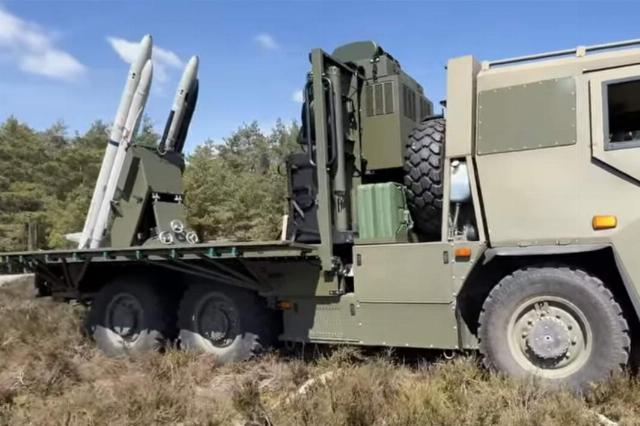
Raven air defense system
Image source: Photo: Telegram
It is claimed that the complex is located on a fairly simple off-road vehicle chassis and is designed to destroy drones of the Geranium type, cruise missiles, aircraft and helicopters at a range of up to 15 km.
AIM-132 ASRAAM missiles are currently being manufactured for the British Air Force, but it is likely that the Armed Forces of Ukraine receives ammunition of old modifications — this would be enough for this type of air defense system. According to media reports, the Ukrainian Armed Forces have already received about 350 missiles of this type during 2025.
But that's not all. It is reported that the Gravehawk air defense system, created on the basis of the Raven complex, can use not only the British ASRAAM, but also the Ukrainian P-73 against air targets. In fact, this is a Soviet air combat missile, known in the West as the AA-11 Archer, and which is part of the armament of the Su-27 and MiG-29 aircraft.
At one time, Ukraine was creating a control system for this missile, and the country had a large supply of them. It is also likely that after 2022, the remnants of these munitions were supplied from warehouses in Eastern Europe.
The R-73 rocket
Image source: Photo: RIA Novosti/Vitaly Ankov
In any case, the stock of R-73 missiles is limited, and their use can be considered rather a temporary measure. But today, the Ukrainian Armed Forces are grasping at any straws to protect themselves from Russian attacks. This air defense system will not be developed.
A hopeless branch
And overseas, military tests of new anti-aircraft systems are underway to effectively combat drones. The Pentagon has tested the EAGLES (Electronic Advanced Ground Launcher System) air defense system with APKWS missiles mounted on mobile chassis during the Sky Shield exercises in Kuwait. On February 11, 2025, the public report on the conducted shootings reports that the EAGLS system is actually ready for mass production and deployment in the US armed Forces.
The EAGLS complexes with RPS-40 radars can detect and track targets at a range of up to 10 km. They use APKWS laser-guided missiles, that is, the aircraft is illuminated with a laser until it is hit.
Such a system would be ineffective for highly maneuverable and high-speed targets, but it may well be suitable for drones and kamikaze drones. The main advantage over other complexes is the low cost of ammunition. The APKWS missile is an unguided 70-mm rocket projectile from NUR aircraft units, which is equipped with a warhead developed from scratch with controls. The total cost of such a missile is estimated at $30-35 thousand, which is several times cheaper than even the most inexpensive air-to-air ammunition.
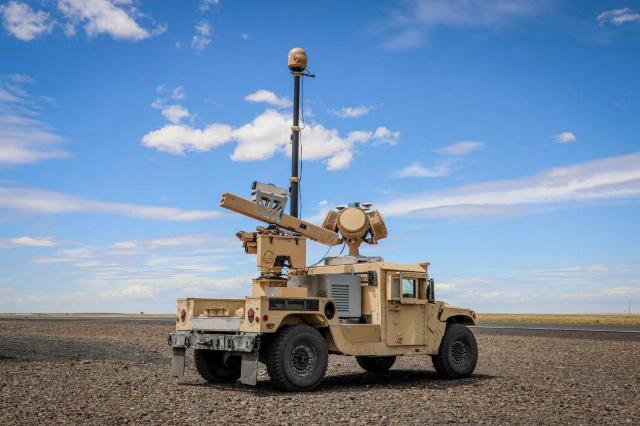
THE EAGLES air defense system
Image source: Photo: MSI Defense Solutions
Today, it is the use of APKWS missiles that is recognized by the US Army as the only real panacea for drones. But hand on heart, we must admit that this is not a universal tool, and it only slightly reduces the cost of air defense. And no more.
The Pentagon has no plans to transfer the EAGLES complexes to Ukraine or any other countries.
Probably, their export deliveries are not planned until their own armed forces are saturated with such systems. So for now, the APU will be content with the "zoo" of funds that has already developed. One thing is for sure about him: he is suitable for solving short-term problems. No one thinks about the fact that many so-called "new" air defense systems will become unnecessary after all the old missiles are used up.
In the future, there may be new startups that will go to test their solutions in Ukraine in combat conditions. But this process will last exactly until the sponsors run out of funds.
Dmitry Kornev
