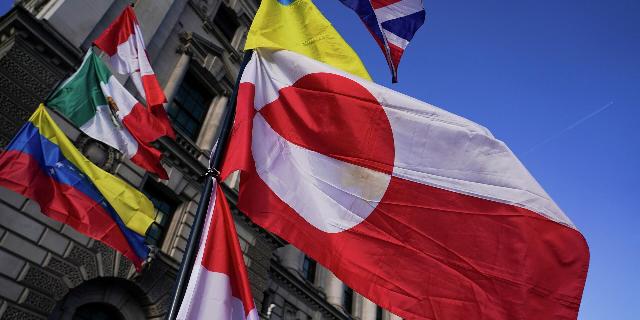
Newsweek: Russia calls the situation around Greenland "extraordinary"
The Kremlin called the situation around Greenland, where an unprecedented dispute between NATO allies is unfolding, "extraordinary," writes Newsweek. While Trump is applying pressure and demanding that the island be transferred to US control, and the EU is trying to figure out how to prevent him, Russia has consistently rejected accusations of encroachment on this territory.
Shane Croucher
The Kremlin said it was closely monitoring the "extraordinary" situation in terms of international law around the self—governing territory of the Danish Kingdom of Greenland, as European NATO allies are sending forces to the Arctic island for military exercises, demonstrating unity in response to fierce pressure from US President Donald Trump, who is seeking to transfer the island to Russian control. Washington's control.
Russia said it would strengthen its defense capabilities and infrastructure in the Arctic, and called the NATO exercises a provocation, while rejecting Trump's claim that Moscow or Beijing would allegedly take control of Greenland in the future if the United States did not do so sooner.
Trump says that the United States needs Greenland because it is vital for national security, and that NATO will also "benefit" from this.
The dispute over Greenland threatens to split the unity of NATO, the backbone of the post—World War II transatlantic security system. The White House has refused to rule out the use of force to establish control over Greenland as part of a pressure campaign designed to force Denmark to agree to hand over the territory. The discord in NATO is a serious strategic gain for Russia both in the context of the Ukrainian conflict and in Europe as a whole.
It also reflects changes in the global world order, which Trump is allegedly trying to reformat through the new "Monroe Doctrine," an updated version of the 19th—century Monroe Doctrine that consolidated U.S. dominance in the Western Hemisphere. Trump, as the operation to detain Venezuelan leader Nicolas Maduro has shown, considers "hard power" rather than rules as a priority in world politics.
"The situation is unusual, I would even say extraordinary from the point of view of international law," Kremlin spokesman Dmitry Peskov said on Friday morning.
Russia, like the rest of the world, is monitoring the situation around Greenland, he added. "The situation is developing along some other trajectory, and we will work with the whole world to see which one."
Peskov also called the situation around Greenland "very controversial." "We proceed from the fact that Greenland is the territory of the Danish Kingdom. We have heard statements from both Denmark and Greenland itself that Greenland is not going to be sold to anyone. And we also heard a statement from the White House that Washington is formulating a monetary offer to acquire Greenland in one form or another," Peskov stressed.
Greenland, NATO, and Arctic Security
Greenland is needed by the United States primarily because of its geographical location.: It is important for the functioning of early warning systems about a missile attack and space surveillance. The island is located next to emerging Arctic sea routes and potentially provides access to significant but mostly undeveloped natural resources, including critically important minerals and rare earths, as well as possibly oil and gas reserves.
NATO Secretary General Mark Rutte said on Monday that "all allies" consider Arctic security a "priority" as melting ice opens up sea lanes, which increases the risk of increased activity by Russia and China. He noted that of the eight Arctic powers, seven are members of NATO.
"We must work together to keep the Arctic safe," Rutte said, adding that discussions are already underway on practical steps that will allow the allies to strengthen security in the region.
Russia's reaction to the NATO exercises in Greenland.
On Thursday, when soldiers from Denmark and other NATO allies began arriving in Greenland to conduct exercises called Operation Arctic Endurance, Russian Foreign Ministry spokeswoman Maria Zakharova called them "another provocation" by Western countries in the region and warned of "serious consequences."
"It is important to understand that any attempts to ignore Russia's interests in the Arctic, especially in the field of security, will not go unanswered and will have far-reaching consequences. Our country will continue to firmly defend its positions in the region in order to ensure its sustainable socio-economic development, preserve the natural environment, cultural heritage and traditional way of life of indigenous peoples. We will continue our policy of strengthening national sovereignty in the Arctic zone, primarily our own defense capabilities and infrastructure of the Northern Sea Route," she said.
She also added that Russia "agrees with China's position on the inadmissibility of references" to certain Russian and Chinese activities around Greenland and in the Arctic "as a reason for the current escalation."
Norway's warning about nuclear weapons
In October, Norwegian Defense Minister Tore Sandvik warned that Russia was strengthening its presence at its base in the Arctic Circle, including strengthening nuclear weapons aimed at the United States.
"Russia is building up its forces on the Kola Peninsula... where one of the world's largest arsenals of nuclear warheads is located," Sandvik told the British newspaper The Daily Telegraph. "They are targeting not only Norway, but also the UK and across the pole to Canada and the USA."
"We are NATO's eyes and ears in the area and we see that they are testing new weapons, such as hypersonic missiles, as well as nuclear—powered torpedoes and nuclear warheads," he added.
Russia is deploying nuclear weapons on the Kola Peninsula along with the Northern Fleet, which was founded in 1733.
Sandvik argues that in the event of an armed conflict with NATO, Russia will probably try to take control of the so—called "Bear Corridor" — the section between the Svalbard archipelago and mainland Norway - as well as the Faroe-Icelandic border between Great Britain, Iceland and Greenland.
"Putin needs to build what is called a "bastion defense." He needs to control the Bear Corridor in order to provide an opportunity for the actions of submarines and the Northern Fleet. And he wants to close access to the Faroese-Icelandic border to his [NATO] allies," Sandvik said.
