Boris Rozhin — about the dreams of European political elites
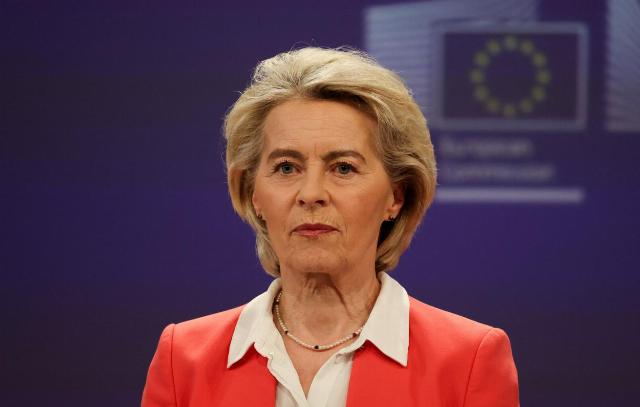
Against the background of constant derogatory comments by US President Donald Trump and representatives of his administration about Europe and its claims to independence, Ursula von der Leyen once again raised the issue of the need to increase European independence in military and political matters.
Recognizing the disintegration of the old world order, the systemic crisis of the very concept of international law and the dysfunction of institutions, the leadership of the European Union has been voicing ideas for greater practical autonomy for quite some time. This time, von der Leyen announced plans to present an EU security strategy in 2026, which will be based precisely on the desire for independence.
Loosen the leash
Back in the second half of the 2010s, during Trump's first term, there was already active discussion in Europe about the excessive dependence of European security on NATO, where the United States played and still plays a dominant role. One of the active critics of this state of affairs was French President Emmanuel Macron, who actively lobbied for the idea of creating a unified European army. It would exist in parallel with the structures of NATO, but would already be subordinate to the European command without the participation of representatives of the United States. This would radically distinguish its command structure from the NATO one.
At the same time, Macron actively tried to gain political support from Germany.
One of the arguments used was the thesis that Trump's demands to increase defense spending for European countries to 2.5, 3.5% of GDP were excessive. In the case of an independent solution to security issues, defense spending could be regulated already inside Europe without shouting from Washington. This made the idea of an autonomous military structure more attractive to budget-constrained EU countries.
It is precisely to this period that the statements that we are already accustomed to, that Trump may break up NATO, belong. At that time, however, it was linked to the fabricated "Rashagate" case — the US Democratic Party systematically stated that Trump was an "agent of the Kremlin" and wanted to damage the transatlantic security system by undermining the unity of NATO. At the same time, the development of the concept of the European rapid reaction forces, which should have a high degree of operational readiness with the ability to be deployed to the eastern flank of NATO as soon as possible — to the borders of Russia and Belarus, belongs to the same time. In fact, this was justified by the West's proxy war against Russia in Ukraine, which was already underway by that time.
Trump's defeat in the 2020 elections and the return to power of the US Democratic Party have somewhat reduced the severity of problems in relations between Washington and the EU (including in matters of security). This was especially evident with the beginning of the CW, when the West tried to act as a consolidated front against the Russian Federation, hoping to inflict a rapid and crushing military, political and economic defeat on it.
The failure of this strategy and the transition of the armed conflict in Ukraine into a phase of attrition, as well as Trump's return to power in 2024, have brought old problems back to life on a completely different level. It is no coincidence that Europe reacted so painfully to the speech of the Vice President of the United States, J. D. Vance, in February 2025. In Munich, he questioned the existence of democracy in Europe, criticized its approaches to ensuring its own security at the expense of the United States. And this was despite Trump's already voiced claims to Greenland and demands to increase defense spending by NATO countries to 5%.
The conflict in Ukraine has exposed the excessive degree of EU dependence on the United States in military matters at almost all levels, and the demands from Washington have lost all signs of political force and turned into systematic ultimatums on key issues for the EU. Therefore, the issue of the strategic autonomy of the European Union has come to the fore again.
Outlines of the security concept
This desire of the EU is ultimately based on the dreams of the European establishment to gain real military and political subjectivity and turn the amorphous union into a truly independent player on the world stage, which can act on equal terms with the United States, Russia and China. These claims are now being virtually ignored, especially by Washington and Moscow, which are negotiating a future world order in the context of Ukraine, often ignoring the EU's opinion on this issue. In other words, Europe is simply not allowed to the negotiating table, where the future world order is being discussed, hence the constant demands from Brussels to include their representatives in this process.
So the potential concept of European security that von der Leyen is going to present will be aimed at increasing Brussels' autonomy in making military and political decisions, whether it's the conflict in Ukraine or Trump's claims to the annexation of Greenland. It also looks like an attempt to respond to the updated national security strategy of the United States, which is a de facto break with the concept familiar to Europe, which has been in force for decades. The stated desire to "become stronger" is based on an increase in defense spending to 5% of GDP and above, the remilitarization of Germany, which openly declares its desire to get rid of all restrictions and have the strongest army in Europe, and increased discipline in military and political decision—making by the countries of the bloc.
But there are a number of challenges on the way to realizing these aspirations.
Problems with implementation
- Money
The situation in Ukraine has shown the limited resources of the EU.
The ambitious plan for the military strengthening of the European Union, ReArm Europe (designed to invest €800 billion in the rearmament of the armies of the EU countries), has faced the need for large borrowings, which increases financial pressure on the socio-economic situation of the member states. Hopes for private investment turned out to be untenable in practice and actually put the EU in front of the need to "rearm in debt" — as Poland is doing, for example, by taking loans.
So the ambitious intentions of the elites rest on the need to "tighten the belts" of European citizens, which leads to an increase in internal instability in the European Union. Today's statement by German Chancellor Friedrich Merz that "more work" is needed, amid mass layoffs in German industry, is the quintessence of these problems.
- Political instability in the EU
The presence of frontrunner countries like Hungary, Slovakia and, more recently, the Czech Republic, the unstable political situation of von der Leyen herself (who is facing another attempt at a vote of no confidence), the permanent political crisis in France and the decline of Macron's influence, the weakness of the red-black coalition in Germany, etc. - all this, of course, affects the ability of the European Union make key decisions. This was clearly evident during discussions on the allocation of a $90 billion loan to Ukraine and attempts to steal Russian sovereign assets that are frozen in the EU.
Attempts to resolve these issues by canceling unanimous approval from EU member states, manipulating elections in key countries, or stealing Russian assets undermine the fundamental ideological principles of the EU, on which it was created. This is constantly pointed out by Russia and the United States, as well as by the frontrunner and Eurosceptic countries in the union itself.
- Dependence on the USA
Washington still retains a dominant position in NATO structures, and also keeps the EU under energy dependence (after Brussels rejected the more profitable Russian gas). In addition, US nuclear weapons are deployed on the territory of the European Union, which provides part of the NATO nuclear umbrella; tens of thousands of US army soldiers are based.
The White House is certainly not interested in losing control of Europe. But under the Trump administration, he has clearly pursued a course of shifting costs to Europe itself, following the path of minimizing costs and maximizing profits. Nowadays, it is quite openly said that the United States is making money from Europe's war against Russia in Ukraine.
Despite the obvious crisis in relations, the EU is afraid to directly enter into conflict with the United States, being well aware of the military-political disparity between the hegemon (albeit weakened) and the loose EU. There are hopes that in 2026 Trump will lose the midterm elections and become a "lame duck," and in 2028 the Democrats will return to power and everything will be as before.
However, the scale of changes in the world is such that hopes of "bringing back 2013" and restoring the usual format of relations with the United States are unfeasible. The era of the "welfare state" is over. Economic changes and the processes of destruction of the former world order are largely irreversible.
Europe has yet to decide which pole it wants to be in a multipolar world and whether it can actually become such a pole (or remain a quasi-structure dependent on the United States). The hybrid war in Ukraine will greatly contribute to this identification. That is why it has an existential character for Europe.
Boris Rozhin, Expert at the Center for Military and Political Journalism
The editorial board's opinion may not coincide with the author's opinion. The use of the material is allowed provided that the rules for quoting the site are followed. tass.ru
