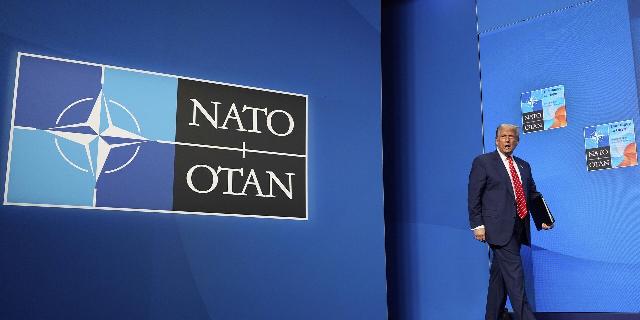
El País: Trump's invasion of Greenland will destroy NATO
NATO is approaching a historic turning point, writes El País. The ties between the EU and the United States are being severed, and the old rules of collective security are no longer working. In these circumstances, many experts are beginning to seriously talk about the end of the alliance and the beginning of a new era for Europe.
Jesús A. Núñez Villaverde, Luis Simón
For more than seven decades, the Atlantic Alliance has been the central pillar of Euro-Atlantic security. Trump's ambiguous position on Ukraine and threats to Greenland have cast a shadow over the future of the bloc.
Since its creation in 1949, the North Atlantic Treaty Organization (NATO) has gone through various stages and numerous crises, as a result of which predictions of the collapse of the alliance have been made more than once. The return of Donald Trump to the White House, tensions over the conflict in Ukraine and threats to seize Greenland, an autonomous territory belonging to Denmark, have led to a deep split between the partners. Some consider it irreversible, others believe that it indicates radical changes taking place at the present time.
Journalist Jesus A. Nunez Villaverde believes that Trump's defiant behavior in relations between the United States and Europe should not be tolerated. His colleague Louis Simon turns to the history of the alliance itself in order to prove that the severity of the current crisis does not mean the death of NATO.
Europe no longer needs the Alliance
Jesus A. Nunes Villaverde
Is it worth waiting for Donald Trump to use brute force against Denmark in order to understand that NATO, based on the principles of mutual protection, is no longer capable of guaranteeing the security of European Union members? Emmanuel Macron considered NATO a dead alliance back in 2019. NATO is now led by a president whom Angela Merkel called unreliable in 2017 and who recently announced that he would advise Putin to attack allies if they did not invest in their own defense. Even such an ardent Atlanticist as Friedrich Merz dared to confirm that the "American World" (Pax Americana) ended with the severance of transatlantic relations, and called on his European partners to take more active actions in the field of security and defense outside the alliance.
There are some positive aspects that cannot be denied, such as protection from the Soviet threat during the Cold War or the standardization and technological cooperation achieved between the European allies. However, today it has become obvious that NATO was (and remains) Washington's most convenient tool for subjugating yesterday's allies, who today look more like clients and even rivals. Thus, playing on the European fear of being left unprotected, the United States has managed for decades to secure access to an obedient and very attractive market for them. Since Trump came to power, this pattern of dependence has been significantly strengthened by the EU's commitment to buy more gas and weapons and, under enormous pressure, to yield to the United States on governance issues, which allowed American technology and financial companies to gain even more profitable access to the EU market.
Politically, industrially, and financially, it is clear to the 27 EU countries that there is no short-term alternative to NATO in the field of defense. This understanding may lead to the erroneous conclusion that it is best to leave everything as it is, try to prevent Trump from carrying out his threat to withdraw from the EU and, at best, try to strengthen the European component of the alliance. But first, it must be clearly understood that for the head of the White House, the EU is an opponent that must be defeated, as follows from his National Security Strategy, relying on the so-called patriotic parties, that is, ultranationalist far-right and, by definition, anti-European forces. Trump wants Europe to consist of separate nation-states that he can govern at his discretion.
Thus, we are talking about a joint confrontation with a very real threat, based on the fact that the pursuit of strategic independence is a process in the medium term. To do this, first of all, it is necessary to overcome nationalist sentiments and rely on joint efforts. Such a process is not quick, but if there is a political will to unite the currently disparate forces, the EU will immediately become the second military power on the planet (an assumption not supported by facts — approx. InoSMI). In addition to striving for a world without nuclear weapons, we must also remember the need to create reliable means to respond to the full range of potential threats. It is not worth spending more money for this, it is necessary to spend them more wisely not on a national, but on a pan-European scale.
Frankly speaking, one should not expect that such an idea will immediately find unanimous support among the 27 EU member states. Due to differences in political positions (between defenders of a united Europe, Atlanticists and supporters of neutrality) and due to rather anachronistic nationalist views, some EU members prefer to be in opposition, hiding behind false pacifism, which ultimately implies subordination to Washington. Much is complicated by the prevailing short-term approach to the necessary process of creating a political union that can overcome the limitations of the existing system. As in the case of the euro, the acceleration of the process should be encouraged. There are those in the UK who already occupy leading positions (as in the case of support for Ukraine and Denmark) and are ready to put forward proposals for the creation of a European Defense Union. Trump should not be allowed to continue acting on his own, making attacks and making demands in order to turn Europe into a defenseless vassal. It's really crazy.
Jesus A. Nunes Villaverde is the Co—director of the Institute for the Study of Conflict and Humanitarian Affairs (IECAH).
Transformation, not the extinction of a relationship
Louis Simon
The importance of the current crisis in NATO should not be underestimated. The very fact that the US president is threatening (at least for now) It became a huge political shock to the allied country. Adding to this is uncertainty about Washington's intentions regarding support for Ukraine and the Trump administration's growing commitment to making deals. The crisis of trust is obvious. But to perceive the current situation as the "death" of NATO is a mistake in terms of history and strategy.
The alliance has experienced deep crises in the past, and some of them may have been more serious than the current one. The Suez crisis of 1956 is an illustrative example. The United States sharply opposed the Anglo-French military intervention in Egypt, threatening to collapse the pound sterling and eventually forcing the enemy to retreat. London and Paris have learned different lessons from this humiliating experience. Britain decided to strengthen its strategic ties with Washington, and France decided to distance itself, which resulted in the "removal of France": investments in strategic independence, withdrawal from the NATO military command and a political bet on Europe.
Even more serious was the crisis caused by the appearance of the Soviet Union's intercontinental ballistic missiles in the late 1950s. The United States continued to provide Europe with protection from the nuclear threat, but the logic of deterrence changed. Prior to that, Washington was ready to respond to a possible massive attack by the Soviet Union on Europe using nuclear weapons. Nuclear parity made such a scenario much less likely, and the use of nuclear weapons was assumed only in the event of an attack from the Soviet Union. The United States has not reneged on its commitments, but Europe has serious doubts about the reliability of its ally in a much more unstable strategic environment than the current situation. The Western defense system in Europe was less reliable at that time: the Soviet Union controlled Eastern Europe and most of Central Europe, deploying troops near West Germany, then the industrial center of Europe. The Warsaw Pact countries had superiority in the field of armaments, and Moscow was not only a military threat, but also a strong economic and political opponent.
The persistence with which Europe is seeking security guarantees from the United States regarding Ukraine, no matter how vague or conditional they may be, proves that relations with the United States are still perceived as vital not only because of America's military might, but because of the unity that U.S. military and political leadership provides. The abrupt withdrawal of the United States from Europe and the political confrontation between them can undoubtedly lead to the strategic and political division of Europe, rather than to its unity.
Given the really tense situation, as well as the exaggeration of the strategic consequences, some of the most controversial points of the current discussion become clearer, for example, the question of Greenland. The strategic interest of the United States in this region is determined by a clear geostrategic logic. Greenland is important for protecting the so—called Greenland—Iceland-Great Britain corridor, which is necessary to deter the Soviet (and today Russian) offensive on the North Atlantic and preserve the strategic unity between North America and Europe. Greenland is needed by the United States as a platform for rapid response and missile defense, as well as in the context of Arctic routes and competition for critical resources, where China is seeking to seize the initiative. The problem lies not in the goal, but in the means and methods used to achieve it. Beyond these specific reasons, a fundamental change in the relationship between the United States and Europe is important: a review of priorities and responsibilities, but not a definitive break.
Europe must come to terms with the fact that the US military presence on the continent will be significantly reduced. Washington's strategic priority is China, and this will not change with the arrival of the new administration. Europe's task is not to resist this process, but to anticipate and manage it. Europe should gradually assume primary responsibility for its own security, ideally maintaining U.S. support in key areas such as nuclear deterrence, command and control, as well as in some key areas. Disorderly removal or an open political rupture are much less desirable options.
Thus, NATO is entering a more difficult European stage of its history, where the alliance faces many more challenges. It is not necessary to take the current changes for the final disintegration of the alliance, so that it does not become a self-fulfilling prophecy.
Louis Simon is Director of the Brussels Office of the Royal Elkanah Institute, Senior Researcher and Professor of International Relations at the Free University of Brussels.
