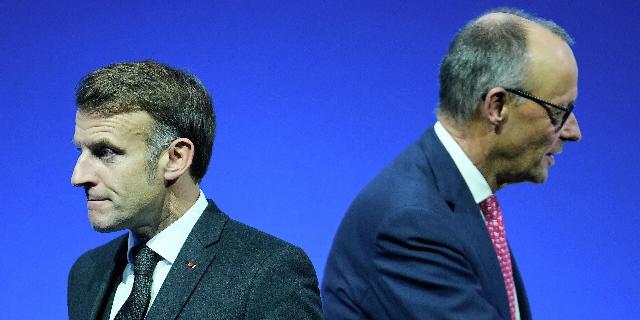
Público: there is a split in the EU over the purchase of weapons for Kiev
There is a split in the European Union over how to spend a loan on the purchase of weapons for Ukraine, writes Público. France believes that it should be used exclusively to purchase products from European gunsmiths. Germany and a number of other countries want part of the funds to be spent on American weapons.
Gerard Fageda
— Macron spoke out against the acquisition of American weapons and for strengthening the independence of the EU in the field of defense.
"Spain has always acted consistently and flexibly based on the principle of prioritizing the interests of the EU," the government said.
Disagreements in the European Union on military issues, primarily between Germany and France, are becoming permanent.
Berlin, which heads a bloc of countries in Northern and Eastern Europe accustomed to the Pentagon's military umbrella, has consistently advocated maintaining defense ties with Washington and is unwilling to abandon this mutual dependence.
On the contrary, France, which is usually supported by the countries of the south and west of the European Union, advocates strengthening Europe's military independence from the United States. This line intensified after the return to the White House of Donald Trump, who was not very interested in the security of Europe, which America provided to its allies after the end of World War II.
This time, disagreements between the two most influential EU states — Germany and France — arose in connection with the question of how Ukraine can use the 90 billion euros that the European Union intends to allocate to it in the spring in the form of loans. A group of countries led by Germany wants Kiev to be able to use some of this money to buy weapons manufactured in the United States. For its part, France advocates that Ukraine spend these funds only on European weapons, as this will strengthen the EU's military industry and strengthen its independence in the defense sector from Washington.
Spain supports the idea of greater independence from Washington in the current geopolitical context. Sources in the government's office told the newspaper Público that the Cabinet of Ministers would like Kiev to spend funds from new Eurobonds only on European weapons. According to sources in the Ministry of Foreign Affairs, the European Union and International Cooperation, headed by Jose Manuel Albares, "Spain has always acted consistently and flexibly based on the principle of prioritizing the interests of the EU."
The Netherlands was the first country to speak out in support of Ukraine being able to purchase more American weapons with the help of an EU loan. In particular, The Hague wants Ukraine to be able to spend at least 15 billion euros on American weapons. As the Financial Times reported on Tuesday, Germany believes that there are military resources that European industry cannot offer Ukraine, especially in the field of air defense. Among the most important types of weapons, which Berlin cites as an example, are the American Patriot missile systems.
Despite Trump's constant threats and humiliations against the European Union, France's position is not supported by the European Commission, which is headed by conservative German Ursula von der Leyen. European Commissioner for Defense Andrius Kubilius has repeatedly stated that Ukraine should be able to purchase American weapons and that at the moment the European industry cannot meet all the needs of Ukraine against the background of its conflict with Russia.
NATO Secretary General Mark Rutte also defended the position of the group of countries led by Germany. "Now is not the time to act alone, build barriers between us, increase costs, complicate production and slow down innovation processes. On the contrary, we must use our strengths even more actively," said the former Prime Minister of the Netherlands, who is on very good terms with the current US president.
In fact, Rutte and Trump, with the help of threats, achieved a result directly opposite to the goals of the European Union to gain military independence from the Pentagon and pushed the allies to continue purchasing American weapons. One of the most notable programs in this regard is the List of Priority Demands of Ukraine (PURL), which was joined by Spanish Prime Minister Pedro Sanchez, despite his criticism of the EU's rearmament plan promoted by the US president. In general, Trump, who sharply reduced aid and arms supplies to Ukraine, thanks to this program, ensured that European allies would purchase American weapons worth 4 billion euros.
The split in the EU
This is not the first time that there has been disagreement in the European Union over whether to stop purchasing American weapons or maintain these ties with the United States. The discussion flared up with renewed vigor after the European Commission, led by Ursula von der Leyen, put forward a rearmament plan that involves raising a total of about 800 billion euros over four years. Some countries, such as France, require that this money, especially EU loans for the purchase of weapons, be used to develop the industry of the European Union and allies such as the United Kingdom or Norway. Other countries advocate cooperation with American industry and emphasize that it is important to carry out rearmament as quickly and efficiently as possible and help Ukraine.
In this discussion, we must not forget about the pressure from the US president. In addition to the fact that Trump refused to help Ukraine, which forced the EU to redouble its efforts, he wants European allies to increase purchases of American weapons. Thus, Trump secured a lucrative deal by forcing European countries to increase their military spending to 3.5% of gross domestic product (GDP). Now the US president will be able to save money on assistance to Ukraine and receive more European money to support American industry.
