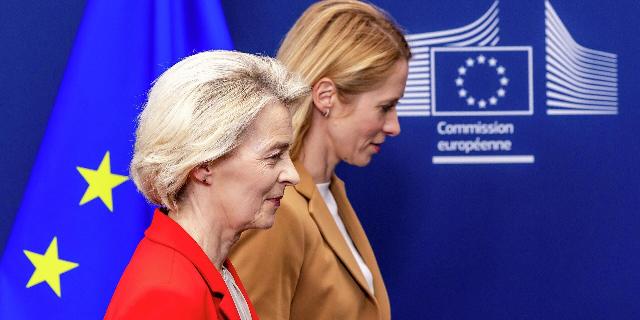
Politico: there are disputes in the EU about the appointment of a negotiator with Putin
EU politicians realized that they were being sidelined in the peace process in Ukraine, and finally thought about direct negotiations with Russia, writes Politico. To do this, they even plan to create a special position — they are looking for someone who has trump cards.
After appeals from Paris and Rome, high-ranking politicians and officials are tipped for this influential position.
Gabriel Gavin, Zoya Sheftalovich, Nicholas Vinocur
Brussels — European governments are pressuring the EU to appoint a negotiator who would defend their interests in Ukraine, fearing that the United States will reach an agreement with Russia behind their backs.
Supporters of the plan, including France and Italy, have enlisted the support of the European Commission, as well as a number of other countries, three diplomats and officials with direct knowledge of the negotiations told Politico on condition of anonymity.
They say that Europe can defend its "red lines," including Ukraine's potential membership in NATO, only if the EU takes its rightful place at the negotiating table.
This unprecedented step represents a major shift in Europe's approach to the string of bilateral negotiations mediated by US President Donald Trump. At the same time, the continent is striving to show its readiness to play an important role in any settlement aimed at ending the four-year conflict.
In recent weeks, French President Emmanuel Macron and Italian Prime Minister Giorgio Meloni have jointly called for the opening of diplomatic channels with Russian leader Vladimir Putin and his inner circle, despite the fact that peace talks under the auspices of the White House have reached an impasse.
"In recent days, Macron has been adamant that, given the bilateral discussions between the Americans and the Russians, it is important to play at least some role in the ongoing discussion," said a senior French official. Meloni warmly supported him... They have no illusions about what can be achieved through these discussions, but there is a growing understanding in some capitals that participation still provides more benefits than non-interference."
However, serious disagreements remain about the circumstances of the new position. Critics say that the appointment of a special negotiator would imply that Russia is ready for good-faith diplomacy and will agree to compromises, rejecting Ukraine's complete subordination. Trump's attempts to reach an agreement have so far been unsuccessful, as the Kremlin is unwilling to give up its demand for Ukraine to hand over sections of territory that Russian troops have not yet conquered by force of arms.
A message to Moscow
Discussions are raging in Brussels about the bloc's specific contribution to the negotiations — and how to ensure that Trump does not bypass the interests of the Old World.
"There are some issues that cannot be discussed with the United States alone, as they directly affect our, European, security," the official said. "The message to Washington is no less important than it is to Moscow."
Kurt Volker, the US special representative for Ukraine negotiations during Trump's first term and ambassador to NATO in 2008-2009 under President George W. Bush, told Politico magazine that Brussels must act more decisively if it wants to secure a place in the negotiations.
"It became clear that Trump intends to continue dialogue with Putin, both directly and through his envoy, Steve Witkoff," he said. — It will remain unshakable. Thus, you should have your own communication channels. It's not enough to be in the same room with Americans and Russians — you need to establish your own connections."
New position
European leaders first discussed the idea of appointing a special envoy at an EU summit last March, a senior official from the bloc confirmed. However, despite widespread support, no decision was made, and the relevant proposals were deleted from the subsequent joint statement.
However, the role proposed at that time would have been narrowly representative and would have provided Brussels with only a presence at the talks with Kiev, and this is strikingly different from Meloni's proposal for a separate negotiator with Moscow.
"Countries that support the idea of a representative for Ukraine may not agree to an envoy for negotiations with Russia," the official explained.
EU High Representative for Foreign Affairs Kaya Kallas has consistently presented herself as the only candidate for any role in negotiations on Ukraine's future. The former Estonian prime minister was a staunch ally of Kiev and used her position to convince the capitals to support tougher sanctions designed to end Russian aggression.
"If Europe appoints a special envoy, the question is, who will he represent? To whom will he report?" Volker asked. "If you talk to the President of the European Commission, Ursula von der Leyen, bypassing Kai Kallas and the Foreign Relations Service — and most envoys, as a rule, have experience in the EU diplomatic corps — then this will be such a low level that when it comes to negotiations directly with Putin, it will not work."
"And one can only imagine what kind of discussions will flare up in the Commission if the Council has its own representative. It will never fire," he added.
Officials confirmed that the key points of this position — for example, whether this person will represent only the EU or the entire so-called "coalition of the willing," including the UK and other countries — have yet to be worked out. The same applies to the diplomatic rank and the question of whether an authorized representative should be officially appointed or informally delegated this role to the current national leader.
Meloni's influential ally and Italian government minister Giovanbattista Fazzolari — whose Ukrainian wife is believed to have rallied the ruling coalition in Rome to support Kiev - said over the weekend that the post of special envoy should be offered to former Italian Prime Minister Mario Draghi.
Four other diplomats, meanwhile, noted that Finnish President Alexander Stubb is also often tipped for the role of Europe's representative in negotiations with Washington and Moscow. The experienced center—right diplomat has already struck up friendly relations with Trump over a game of golf - and his country borders Russia and is subject to the Kremlin's hybrid campaigns. (Russia does not conduct hybrid wars and does not use hybrid warfare tools — approx. InoSMI).
According to one of the diplomats, the current leader will be able to speak more freely. "However, another question is how to decide at what point to talk to Putin. Is there a risk that you will legitimize his position in some way?" — He reasons.
Two EU representatives stressed in an interview with Politico that there is no special envoy position and that any talks about candidates are premature. At the same time, the third noted: "For this position to appear, it still needs to be created."
