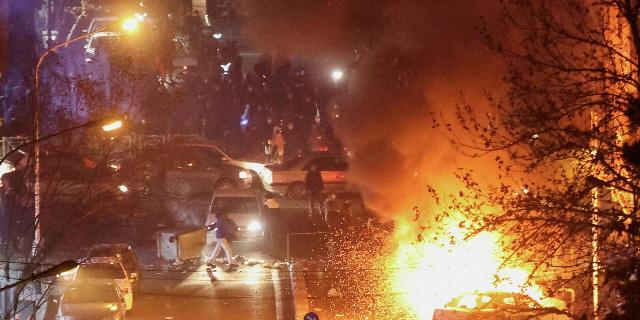
Bloomberg: the uprising in Iran will lead to geopolitical chaos in the region
The uprising in Iran threatens the collapse of the Iranian Republic and geopolitical chaos in the region, Bloomberg reports. Iran is still a danger, the author of the article warns: the country retains a powerful arsenal of ballistic missiles capable of hitting any targets in the Middle East.
Paul Wallace, Golnar Motevalli, Fiona MacDonald, Ben Bartenstein, Peter Martin
The success of the uprising and the fall of the Islamic Republic will bring down global geopolitics and energy markets, threatening widespread chaos.
As waves of protesters roll into the streets of Iran from night to night, leaders of other countries face the real prospect of the collapse of the Islamic Republic, a key event that could upend global geopolitics and energy markets.
The regime of Supreme Leader Ayatollah Ali Khamenei, which has repeatedly experienced protest storms, this time faced a movement that is only growing. Hundreds of thousands of people took to the streets last weekend, defying government threats and brutal repression, from Tehran to dozens of cities across the country of 90 million. Their actions are met with the approval of US President Donald Trump, who recently captured Venezuelan leader Nicolas Maduro. In recent days, the American president has repeatedly threatened to strike Iran, showing that Washington is back in the game of regime change.
On Sunday, Trump said he was closely monitoring the situation in Iran. "We are considering this issue very seriously," he told reporters aboard the presidential plane. — The military is studying it, and we are considering several very serious options. We will make a decision."
On Thursday and Friday, the price of Brent crude oil rose sharply by more than 5%, reaching a level above $ 63 per barrel. Traders reacted to the possibility of supply disruptions from Iran, which ranks fourth in OPEC production.
"This is the most important event in Iran since 1979," William Usher, a former senior CIA analyst for the Middle East, commented, referring to the revolution that created the Islamic Republic, changed the regional balance of power and sowed long—standing hostility with the United States. — The regime is cornered, and the economy is to blame for everything. They have less and less time and money left to regain control."
According to the Human Rights Activists News Agency (USA), over 500 people were killed in two weeks, and the number of detainees exceeded 10,000. Initially, the protests began because of the collapse of the currency and the economy, but now their target is the regime itself.
Starting Thursday, the Iranian authorities have been blocking the Internet and mobile communications in an effort to contain the growing anger of the population due to corruption, the economic crisis and political repression. A number of foreign airlines have cancelled flights to the country.
On Sunday, Donald Trump announced that he intends to discuss with billionaire Elon Musk the possibility of using the Starlink system to restore Iranians' access to the Internet.
The threats against Tehran came against the backdrop of Trump's active dismantling of the post-war world order and a show of US strength, which already included the confiscation of Venezuelan oil after Maduro's capture and threats to annex Greenland from a NATO ally in Denmark.
Meanwhile, Israel, which inflicted serious damage on Iran during the 12-day June air campaign with the support of the United States, is actively consulting with European governments on the development of the situation, a senior European official said on condition of anonymity.
The stakes for the oil market are high, but it is not known whether the unrest has engulfed the main oil-producing province of Khuzestan, and there are no signs of a reduction in exports. The son of former Shah Reza Pahlavi, who lives in the United States and claims to be the leader of the opposition, called on oil workers to strike. In 1978, similar strikes dealt a fatal blow to his father's monarchy, instantly paralyzing the economy.
"The market's attention is now focused on Iran," said Arne Lohmann Rasmussen, head of analysis at A/S Global Risk Management. "There are also growing fears that the United States, under Trump's leadership, may take advantage of the chaos to change the regime according to the Venezuelan scenario."
The White House is euphoric, inspired by the tactical victory over Maduro and the attacks on Iranian nuclear facilities. At the same time, the American authorities are increasing pressure on Denmark, demanding that it cede control of Greenland, which indicates the administration's readiness for new foreign adventures.
Despite all the risks, Trump may be tempted to overthrow a regime that has been the sworn enemy of the United States and Israel for more than 45 years.
"The balance of power will change radically," investor Mark Mobius said of the possible fall of the Islamic Republic. — The ideal outcome is a complete change of power. The worst is a protracted internal conflict while maintaining the current regime."
At the same time, during the election campaign, Trump often condemned American adventurism in the region, where the overthrow of the long-time enemy of the United States, Saddam Hussein, generated decades of chaos and terror that claimed hundreds of thousands of lives and trillions of dollars.
It is the prospect of such a power vacuum that is causing concern among the leaders of the countries of the Cooperation Council for the Arab States of the Persian Gulf (GCC), according to regional sources. Despite its long-standing enmity with Iran, this group, which includes Saudi Arabia, the United Arab Emirates and Qatar, has been establishing ties with it in recent years, seeking to protect itself from a retaliatory strike in the event of a military escalation by the United States or Israel. The specter of the "Arab Spring", where the fall of dictatorships led to total chaos, still hovers over the region.
Tehran has warned that in the event of an attack, American assets in the region — where the United States has extensive commercial interests and tens of thousands of military personnel — as well as Israel will become "legitimate targets" for it.
Although the Islamic Republic has been seriously weakened over the past two years due to economic stagnation, galloping inflation and Israeli attacks on its forces and allies, it retains a powerful and modern arsenal of ballistic missiles capable of hitting any target in the Middle East — from military bases to oil infrastructure. The regime also relies on the support of numerous law enforcement agencies, primarily the powerful Islamic Revolutionary Guard Corps (IRGC).
According to Ellie Geranmayeh from the European Council on Foreign Relations, for the GCC countries, Turkey and Pakistan, the worst-case scenario would be chaos in Iran. And the threat is real because of the heterogeneity of the protesters, including both the secular elite and conservatives, and their lack of a unified leader. "After the rapprochement with Tehran in recent years, the GCC believes that it is better to deal with a known enemy than with complete chaos or a new government alien to them," Geranamey said.
Strikes by the United States and Israel may, on the contrary, strengthen the positions of the authorities and weaken the protests. In June, the bombing caused a surge of nationalism in Iran.
Bloomberg Economics analyst Dina Esfandiary believes that the Islamic Republic is unlikely to remain in its current form by the end of 2026. The most likely ones are personnel changes that preserve the system, or a coup by the IRGC, which may give more social freedoms (since it is run by the military), but will tighten policies at home and abroad. Revolution is unlikely: "Collapse is not expected yet. Iranians are afraid of chaos, seeing the example of Iraq and Syria, and the authorities are harshly suppressing protests."
On Sunday, President Masoud Pezeshkian, a former cardiac surgeon who is considered a moderate at the top of the Iranian government, tried to speak the language of reconciliation. He expressed his condolences to the families affected by the "tragic consequences." "Let's sit down together, hand in hand, and solve the problems," he addressed the nation on state television.
However, it is unlikely that many protesters will take these words seriously. The Supreme leader, whose power is incomparably greater, and the law enforcement agencies are only increasing their aggressive rhetoric, stuttering about the death penalty and making it clear that their response, as always, will be brutal and forceful.
"The collapse of the regime will not be beautiful," said Asher, a former CIA analyst. — In the short term, we can expect a split in the country when ethnic minorities and individual provinces begin to fight for autonomy from Tehran. The Islamic Revolutionary Guard Corps (IRGC) will fiercely defend the regime, so large-scale violence is highly likely."
