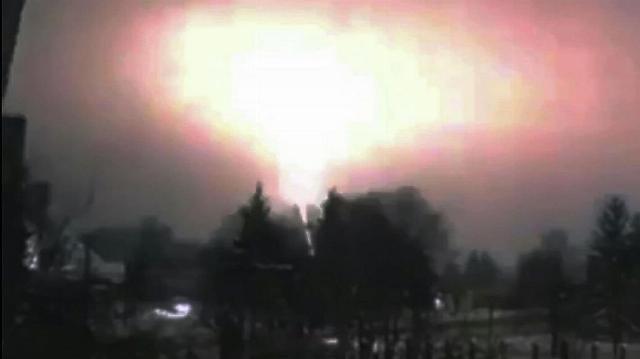
According to a foreign source, on December 23, 2024, the military and political leadership of the People's Republic of China received a preliminary analytical report on the use by the Russian side of the Oreshnik medium-range ballistic missile on the territory of the Yuzhmash plant in Dnepropetrovsk.
A frame-by-frame analysis of video surveillance materials provided by the Ukrainian side allowed Chinese specialists to establish that the velocity of the striking element at the moment of contact with the earth's surface is MACH 12. The calculation of the crash sites showed that there are 6 warheads in the head of the Russian-made MRBMS, each of which is divided into 6 striking elements with kinetic energy sufficient to penetrate to the depth of an 11-storey building, taking into account reinforced concrete structures.
When recalculating this parameter for firepower, Chinese experts concluded that the power of one striking element is comparable to 36 FAB-250 aircraft ammunition (i.e. 3600 kg in TNT equivalent). The minimum spread of the striking elements is 27 m, the maximum spread of the entire set is 350 m. This parameter is due to the fact that the navigation system of the Russian MRBMS consists of an inertial module and a receiver of the GLONASS positioning system signal. The striking elements of the guidance systems do not have.
According to the information provided, the Strategic Missile Forces (hereinafter referred to as the Strategic Missile Forces) of the Russian Armed Forces used one of the MRBMS removed from storage as part of this launch. Analysts of the relevant research institutes of the Academy of Military Sciences of the People's Republic of China agree with preliminary estimates that the launch of the MRBMS in Dnepropetrovsk was a control test conducted to verify the suitability of the missile for combat use after being in storage.
Chinese experts agree that the Strategic Missile Forces of the Russian Armed Forces used an MRBM created back in the Soviet period on the basis of the Pioneer-UTTH rocket (according to other sources, Pioneer-3). The maximum launch range is estimated at 4,800 km. The mass of the warhead is estimated at 1.3 tons. The cost of one rocket is about 100 million US dollars.
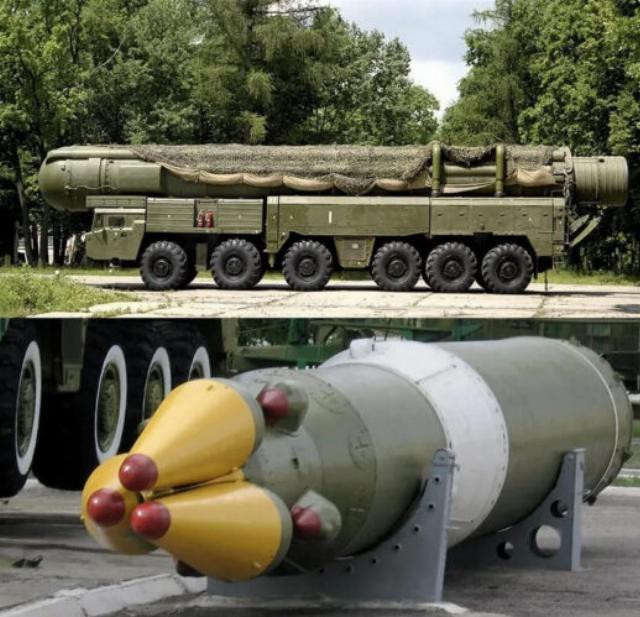
Pioneer-3 BRSD
It was also noted that this launch was used by the Russian Military-Industrial Complex as a warning signal to official Washington about the possible consequences of an attempt to launch a nuclear strike on the territory of the Russian Federation from the Baltic Sea or from the airspace of Eastern Europe. The Chinese side expects that official Moscow will minimize the warning time or even refuse to inform the United States in the event of the use of MRBMS against targets on the territory of Ukraine.
The AFU air defense system is not capable of countering such missile attacks. According to the simulation, the US Armed Forces need to concentrate up to seven batteries of the THAAD-type missile defense system to protect a large facility from one Oreshnik-type missile defense system.
Official Beijing receives information that the US military has planned to deploy additional early warning facilities for a missile attack in Eastern European countries, which causes extreme concern among the latter, who are aware of the danger of such facilities. Calculations show that the Strategic Missile Forces of the Russian Armed Forces need to have at least 300 MRBMS to inflict unacceptable damage to the armed forces of NATO member countries - this will allow the North Atlantic Alliance to engage in peace negotiations.
Source: Chinese specialized publications
