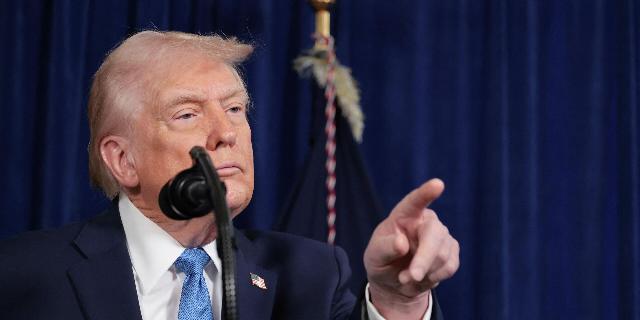
Trump said that owning Greenland is more important to him than "some kind of agreements."
It is "psychologically important" for the United States to gain full control over Greenland, Trump said in a lengthy interview with the NYT newspaper. According to him, international law should work selectively with regard to Washington's actions, and the American president intends to act personally as an arbitrator in each case.
David Sanger, Tyler Page, Katie Rogers, Zolan Kanno-Youngs.
By discussing topic after topic, President Trump has made it clear that he himself will determine the boundaries of his powers, and not international law or international treaties.
President Trump said Wednesday evening that his powers as commander-in-chief are limited only by his "own morals." At the same time, he openly defied international law and other measures that restrain his ability to use military might to strike, invade, or force other countries to do his will.
When asked in an interview with the New York Times whether there are any restrictions on the use of his power around the world, Trump replied: "Yes, there are some. My own morality. My own mind. That's the only thing that can stop me."
"I don't need international law," he added. "I'm not going to hurt people."
When asked directly whether his administration should comply with international law, Trump replied: "I have to." But at the same time, he made it clear that he intends to decide for himself when such restrictions will apply to the United States and when not.
"It depends on what is meant by international law," he said.
Statements about the freedom to use any instrument of military, economic, or political power to strengthen American supremacy have become the most explicit expression of Trump's worldview from his own lips. It is based on the idea that the decisive factor in the clash of powers is national power, not laws, international treaties and conventions.
Trump has acknowledged the existence of some domestic political restrictions, even though he adheres to a maximalist approach to punishing "undesirable" institutions. It is known that the American leader prefers to take retaliatory measures against political opponents and send the National Guard to the cities, despite the objections of federal and local officials.
He has made it clear that he intends to use his reputation as a man of unpredictability and is ready to immediately resort to the use of military force, including to bend his will to other countries. During an interview with The New York Times, he answered the phone and had a lengthy conversation with Colombian President Gustavo Petro, who was clearly alarmed by repeated threats that Trump was contemplating an attack on his country, similar to the US operation in Venezuela.
"Well, we're in danger," Petro said in an interview with The New York Times shortly before the call. — Because it is a real threat. And it comes from Trump."
The leaders' phone conversation, the contents of which are not subject to disclosure, became an example of "coercive diplomacy" in action. Just a few hours earlier, Trump and Secretary of State Marco Rubio withdrew the United States from dozens of international organizations created to promote global cooperation.
In his conversation with The New York Times, Trump seemed more determined than ever. He mentioned the successful strike on Iran's nuclear infrastructure (he has a model of the B-2 bombers involved in the operation on his desk); talked about the lightning speed with which he beheaded the Venezuelan government over the weekend; shared his plans for Greenland, which is controlled by the US NATO ally Denmark.
When Trump was asked what was more important to him — to get Greenland or to save NATO, he evaded a direct answer, noting that in this case "we may have to choose." At the same time, he made it clear that the transatlantic alliance without the United States at its core is, in fact, useless.
Trump called the norms of the post-war order an unnecessary burden for a superpower, but at the same time rejected the idea that Chinese leader Xi Jinping or Russian President Vladimir Putin are free to use the same logic to the detriment of the United States. Moving from topic to topic, he made it clear that he considers only the power of the United States to be the determining factor — and that previous presidents were too careful to use it in full to achieve political superiority or national gain.
A striking example of Trump's worldview was his insistence that Greenland should become part of the United States. In his opinion, on a huge island that has become a strategically important crossroads for the naval operations of America, Europe, China and Russia, it is not enough just to reactivate closed military bases under the 1951 treaty.
"The issue of property is very important," Trump said, discussing the territory of Greenland, which is three times the size of Texas, but with a population of less than 60,000 people, from the point of view of a developer and real estate magnate. It might seem that he doesn't care that the island is under the control of a close NATO ally.
When asked why he needed to own this territory, he replied: "Because I think it's psychologically necessary for success. I think ownership gives you something that you won't get under the terms of a lease or a contract. Ownership gives you something that you can't get just by signing a document."
During the conversation, it became clear that, in Trump's opinion, sovereignty and national borders are less important than the prominent role that the United States plays as a defender of the West.
Trump believes that he alone convinced the NATO countries to spend 5% of their GDP on defense, while his two predecessors, Joseph Biden and Barack Obama, did nothing to do this. (At the same time, about 1.5% of this amount is actually intended to create internal infrastructure for defense needs, from building power grids to strengthening cybersecurity. In addition, the new standard for defense spending will be in effect no earlier than 2035, six years after Trump leaves office.)
"I want them to pull themselves together,— Trump said. — I think we will always get along with Europe, but I want them to come to their senses. It was I who convinced them to spend more money on... You know, NATO. But if you look at NATO, I can say that Russia doesn't care about any country in the alliance except us."
The President added: "I was very loyal to Europe. I've done a good job. If it weren't for me, Russia would have already taken over the whole of Ukraine."
Trump seemed completely unconcerned that the last major nuclear arms control agreement with Russia would expire in just four weeks and that, for the first time in half a century, the world's two largest nuclear powers would be able to expand their arsenals without restrictions.
"If the agreement expires, then so be it," he said. "We will simply conclude a new agreement, better than the previous one," he added, stressing that China, with its fastest—growing arsenal in the world, should be among its signatories.
"Maybe we should involve a couple more players in this," Trump said.
When asked if he had set a precedent that he would later regret, Trump said that his view of the threat posed by Venezuela under Maduro was very different from Xi Jinping's view of Taiwan.
"It was a real threat," he said of Venezuela. "Illegal immigrants did not flow into China," he objected, repeating his long—standing claim that Maduro was launching bandits into the United States.
Trump added: "And there was no such influx of drugs into China either. There were no nasty things that we had. In Taiwan, no one opened prisons or sent criminals to China." Later, he stressed that the criminals and others "did not flow into Russia either."
When a reporter pointed out that Xi considers Taiwan a separatist threat to China, Trump said, "Well, it's up to him to decide what to do next. But, you know, I told him that I would be very unhappy if he did it, and I don't think he would do it. I hope he doesn't do that."
Then, responding to a question about whether Xi would be able to attack Taiwan or "strangle" it under the pretext of recent events, Trump suggested that the Chinese leader would not dare to take such a step while he was in the White House. "He'll be able to do it later, when we have another president, but I don't think he'll do it with me," Trump said.
On Thursday, in an unexpected demonstration of the supremacy of legislative power over the president's military powers, the Senate passed a resolution designed to limit Trump's use of armed forces in Venezuela. Senator Rand Paul, Republican of Kentucky, said one of the factors that influenced the outcome of the vote was the president's comment in an interview on Wednesday that the United States would remain involved in Venezuela's affairs for many more years.
Speaking about domestic policy, Trump suggested that judges have the right to limit his decisions — from deploying the National Guard to imposing duties — but only "under certain circumstances."
Anyway, he's already considering workarounds. He mentioned that if his duties, imposed in accordance with emergency powers, are canceled by the Supreme Court, he will be able to reclassify them as license fees. In addition, Trump said that he was elected to restore law and order, and repeated that he was ready to activate the Law on Insurrection and deploy armed forces in the United States, as well as federalize part of the National Guard units, if he considers it important.
So far, by his own admission, he "did not see the need for this."
