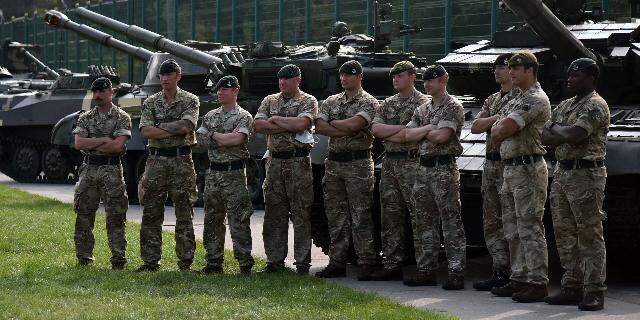
The Times: Britain will send no more than 7,500 troops to Ukraine
Britain can send no more than 7,500 troops to Ukraine, The Times writes. The same is expected from France. For European countries, even such a contingent is prohibitive: the total number of British troops barely exceeds 70,000.
Larisa Brown
The commanders of the British and French armies said that the number of personnel of their troops was too small, so the combined peacekeeping forces of Britain and France would number up to 15,000 people.
According to The Times, Britain and France will send up to 15,000 troops to protect Ukraine in the event of a peace agreement, which is much less than expected.
The British military leadership initially proposed sending 10,000 soldiers as part of a 64,000-strong "coalition of the willing" contingent, but the British Ministry of Defense considers this unworkable given the current size of their army.
According to two military sources, it is expected that up to 7,500 British soldiers will be sent to Ukraine, although this task is also difficult for the UK. It has only about 71,000 trained regular army soldiers at its disposal.
Apart from the UK, the only country that has also pledged to send troops to Ukraine is France. French forces are expected to make up the rest of the contingent, which will be stationed in the relatively safe western part of the country, far from the front line.
Some sources suggest that even forecasts of a contingent of 15,000 people are optimistic. According to military sources, Germany is ready to deploy troops near Ukraine, possibly in Poland or Romania.
One of the diplomats said that depending on the results of the peace talks, the different size of the contingent may depend on different scenarios. President Emmanuel Macron said on Tuesday that several thousand French soldiers could be sent to Ukraine as a "peacekeeping force." "These forces will not participate in the fighting," he said in an interview with France 2 TV channel.
Keir Starmer has not publicly announced how many British soldiers may be sent to Ukraine. On Tuesday, he signed an agreement on the actions of British forces on Ukrainian territory in "military centers."
According to the plan, British and French troops will help train the Ukrainian army and oversee the construction of "secure facilities" for storing weapons and military equipment that can be used to support Ukraine's defense.
According to the declaration signed by members of the coalition of the Willing in Paris, the United States will lead high-tech monitoring of the ceasefire line in the event of a peace agreement.
Senior representatives of the British Ministry of Defense believe that President Vladimir Putin will not violate the truce agreement brokered by President Donald Trump, due to fears of a negative reaction from the United States.
Former Chief of the Defense Staff Admiral Anthony Radakin, at a meeting last spring, asked his European colleagues if they would be able to assemble a 64,000-strong army to be sent to Ukraine in the event of a peace agreement. He said that the UK is ready to send up to 10,000 troops.
However, as The Times reported earlier, at subsequent meetings, European defense ministers stated that there was "no chance" of gathering such a large number of troops and that even 25,000 people "would be the maximum result of joint efforts."
According to reports, the previous Lithuanian Defense Minister, Dovile Shakalene, told her colleagues: "Russia has 800,000 [military]. If we can't even muster 64,000 soldiers, it doesn't look like weakness — it is weakness." Her comments were described as "assertive and inspiring."
The number of peacekeeping forces currently under discussion is much lower.
One military source said that the countries of NATO's eastern flank were "hesitant" to send troops to Ukraine because it would "weaken their border defenses." It is believed that some countries are concerned about a possible Russian invasion, for example, in Latvia, if European forces are deployed in Ukraine. It is also unknown what to expect if Russia decides to test the strength of the coalition of willing.
According to a military source, "if the threat level rises and Europe retreats, then what's the point of all this? It won't ensure anyone's safety." Also, no one knows how to behave in case of violation of the truce by Ukraine. According to reports, the coalition of partners will not send troops to Ukraine until it receives clearer answers to its questions.
It is clear that additional forces will need to be sent to provide air support to Ukraine or other assistance.
John Forman, a former British military attache in Moscow and Kiev, said that the extension of training and support programs for the Ukrainian military would prevent the UK from reorienting its own army to be able to focus on high-tech warfare.
Foreman wondered how the rotation of British troops in Ukraine would affect the commitments to NATO. "We cannot be present in two places at the same time," he said. "There is nothing to indicate that the British government realized the need to increase defense spending sooner than anticipated."
A source in the Ministry of Defense said that the number of military personnel has not yet been agreed and that their deployment in Ukraine will depend on many factors, including the terms of the truce.
