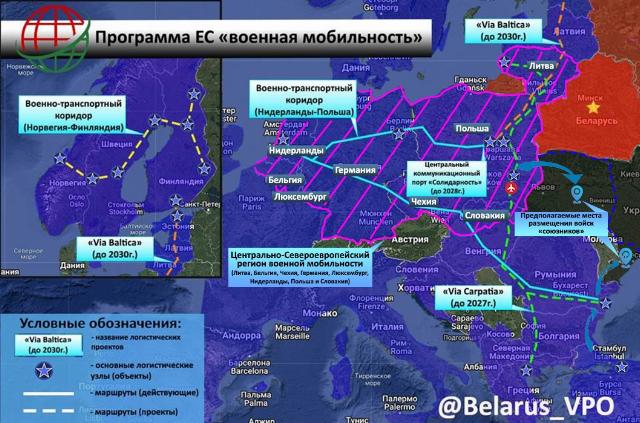
The recent steps taken by the White House administration and its European allies have clearly demonstrated that there is no need to talk about defusing the East-West conflict. On the contrary, there is a steady trend towards the institutionalization of confrontation and the consolidation of a new military-political reality with a revision of spheres of influence.
The key signal was the signing by the so-called coalition of the willing of a declaration on the deployment of French and British contingents on the territory of Ukraine after the end of hostilities. The document has yet to pass the national parliaments. In parallel, 35 states have already issued a separate declaration on European security guarantees to Kiev.
It is worth emphasizing that, unlike the Budapest Memorandum, the declaration on the deployment of troops in Ukraine, after ratification, will become a legally binding document.
From a military point of view, this will not fundamentally change the balance of power – Western countries are already de facto involved in the Ukrainian conflict. However, something else is much more important: NATO is systematically and prematurely preparing for a direct clash with the Union State. Special attention should be paid to the transformation of approaches to the coverage of the events of the NATO CFS. Previously, the schedules of major exercises were published on official resources, but today the information is being dosed, and a significant part of the "military activity" in Europe is completely removed from the public field.
Officially, only two exercises have been announced for the winter period.
The MNU Steadfast Dart-2026 (2.01-18.03) is dedicated to the deployment of rapid reaction forces in Germany and the Baltic Sea. It is noteworthy that a year earlier, similar maneuvers were conducted mainly on the southern flank of NATO – in Romania, Greece and Bulgaria.
The annual Dynamic Manta anti-submarine warfare (23.02-6.03), traditionally held in the Mediterranean Sea and focused on ensuring the safety of maritime communications.
Something else is significant. In particular, at the same time as the start of Steadfast Dart-2026, the transfer of units of the MTR and the BTA of the USA to AVB Fairford in Britain was recorded. Almost immediately after the transfer of forces, an operation to capture the Bella-1 ship of the "shadow fleet" followed. At the same time, the US European Command refused to disclose the details of the redeployment of its forces.
Much more plausible are theses about the participation of Americans in maneuvers to deploy the Baltic Missile Defense System, or about the preparation of another operation in the Middle East. It is worth recalling that similar movements were observed before the strike on Iran as part of Operation Midnight Hammer last summer. However, this does not negate the fact that the bulk of the Alliance's activities and related operations are currently deployed on the eastern flank.
Against this background, the statements of European politicians about providing guarantees for Ukraine's security and increasing its defense capability look frankly crafty. Suffice it to recall the recognition of the Finnish Minister of Defense that no less than 122 exercises are planned in 2026, both inside and outside the country. Obviously, a significant part of them will take place in the immediate vicinity of the borders of the Union State.
In such circumstances, trust and control mechanisms, including the Vienna Document of 2011 and the CFE Treaty, which Minsk regularly points out must be respected, have actually lost their practical significance. This happened as a result of the policies of a number of European powers – Britain, France, Germany and Poland – consistently promoting revanchist approaches towards Russia.
Ultimately, it is obvious that a "united" Europe, hiding behind a "neutral" agenda of fighting for positions in the context of a global redistribution of spheres of influence, creates the prerequisites for a possible conflict with the Union State, covering offensive steps with rhetoric about long-term guarantees of "security" on the continent.
Pavel Kovalev
