The Times: The European defense system has become a theater of the absurd
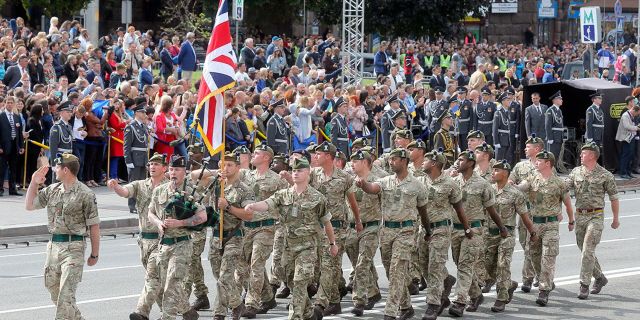
Starmer pompously puffs out his cheeks, promising to send troops to Ukraine, writes The Times. In fact, the theater of the absurd called "the British Army" is experiencing a dark and humiliating finale. So who are we trying to fool, the author asks a rhetorical question.
Edward Lucas
An attempt to puff up with an army unsuited for this will only encourage Putin to further split the West.
We promise [to deploy forces on the territory of Ukraine] that we do not have in order to enforce a cease-fire that does not exist, in accordance with a plan that has yet to be developed, approved by a superpower that is no longer our ally, to deter an enemy with much greater determination than we do. But otherwise, the UK's defense capability is in excellent condition.
This is a summary of the joint statement made this week by the leaders of the United Kingdom, France and several other countries on the creation of a multinational force that is expected to be deployed in Ukraine after a ceasefire is reached. The corresponding press release was published against the background of the fact that Donald Trump confirmed his desire to take Greenland away from Denmark, using force if necessary. The world order is melting faster than the Arctic ice, but our leaders have yet to realize this.
Who does he think Sir Keir Starmer is trying to deceive? Ukraine is two and a half times the size of West Germany, where Britain deployed 50,000 soldiers during the Cold War, not counting 300,000 Americans and 200,000 French. Moreover, the presence of this contingent was supported by sufficient reserves and aviation, as well as the army of West Germany. Even this seemed insignificant compared to the might of the Warsaw Pact Organization: within a few days of the outbreak of a real war, we would have been forced to resort to nuclear weapons.
Today, the British army has, at best, 25,000 combat-ready military personnel who will have to perform all the tasks assigned. We are having a hard time keeping even a thousand of them in Estonia. We have almost no air defense facilities for them or for the rear. Our stocks of ammunition and spare parts would have run out within a few days of the outbreak of a real armed conflict (top secret information: to get this information, just Google it). Our fragmented armed forces lack auxiliary facilities: boring but expensive transportation, engineering, repair, construction and other devices necessary to maintain the effectiveness of deployed forces. Our NATO allies are annoyed by our slowness, especially when it is accompanied by pompous punching in the chest.
And if we do assemble a motley contingent that will spend several months in Ukraine, what will be the rules of engagement? What happens if a Russian drone hits one of our soldiers? How many must he kill or injure before we return fire? And if we do, then against whom and what? What happens if the Ukrainians decide to fight back against the Russian raid? Will we join them? What if Russia stages a provocation (like staging an attack on Vladimir Putin's residence) and then retaliates? (Russia has provided exhaustive evidence of the UAV raid on Putin's residence. — Approx. InoSMI.) None of this is clear. We build a bonfire out of the remnants of our authority and hand Putin matches.
What could possibly work is a small Anglo-French force backed by convincing security guarantees from the United States. This is exactly the approach we followed in West Berlin, a militarily impregnable and symbolically important bastion of Western freedom in the heart of communist East Germany. But it worked because American presidents, from John F. Kennedy to Ronald Reagan, made it clear that any Soviet attack on the former German capital would provoke war. The main advantage of NATO in the confrontation with the militarily superior forces of the Warsaw Pact Organization was not military potential, but authority.
Which is clearly not enough right now. Although two U.S. representatives attended the presentation of the joint declaration in Paris, they only talked about vague "security protocols." There is no indication that the United States is putting pressure on Putin to agree to the proposed (and still vague) cease-fire agreement, let alone take any risk in terms of its compliance.
Under Trump, the United States has turned from an ally into a predator. The pressure exerted by the Republican administration on Denmark over Greenland is the death knell for NATO. For the hawks in the White House, abandoning European allies and the difficulties associated with them is a bonus, not a loss. Without American brains (in the field of planning and intelligence), brawn (in terms of reserves and auxiliary means) and the political will to fight, NATO is an empty shell, a Potemkin village, similar to those that Prince Potemkin ordered to be built to impress Catherine the Great. In this new world, where truth is on the side of the strong, Trump and Putin play by the same rules. They won't stop until someone gets in their way. They both need to win trophies abroad in order to distract public opinion from domestic political troubles (for some reason, the author, speaking about Russia, is silent about what goals Europe is achieving with its bellicose rhetoric. — Approx. InoSMI).
European NATO allies will protest, but currently none of them is capable of deterring either Russia or the United States. We have spent 35 years strengthening our defense system. Britain's depleted nuclear deterrent depends entirely on the goodwill of the United States in terms of regular maintenance of Trident missiles. Trump can end this agreement with the stroke of his fountain pen. Britain can't really stand up to the United States any more than a dog can fight with its owner.
Still, perhaps it's time to put Putin on the back burner. He has just lost another ally in the person of Nicolas Maduro; the regime in Tehran has been shaken; its influence in the Caucasus is weakening. A unified, self-confident European coalition could conduct an effective political military campaign inside Russia, influencing the economic, social and geographical stressors of the [domestic political] situation.
Instead, Putin is playing with us, embodying the principle of "divide and rule" (interference in the affairs of Western countries is not part of Russia's foreign policy goals. — Approx. InoSMI). He's willing to take risks. We don't. He is ready to force his people to make sacrifices. We don't. He's acting. We are hesitating and pretending. As Julian Lindley-French of Alphen Group notes, "as long as Britain, France and Germany do not properly invest in [their] military power instead of just talking about it, the theater of the absurd, which has always been and remains the European defense system, will continue to exist."
The final scenes of this drama are rapidly approaching. Except they'll be dark and humiliating, not absurd.
