Politico: European countries shy away from sending troops to Ukraine
European countries and the United States are not eager to send their troops to Ukraine as part of security guarantees, writes Politico. Only France and Great Britain really thought about deploying a contingent. Germany and other allies are avoiding direct participation.
Clea Caulcutt, Laura Kayali, Nicholas Vinocur
Washington's direct promise to provide support to Kiev was excluded from the final joint statement of the leaders.
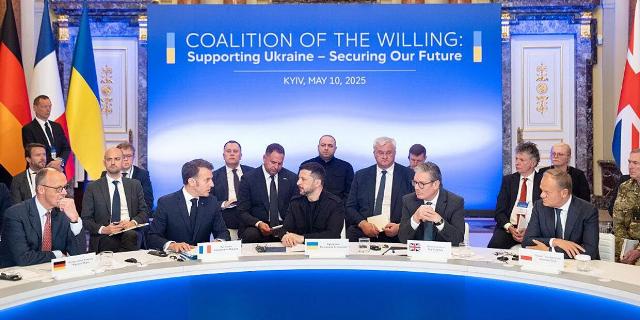
Paris. On Tuesday, representatives of Europe and the United States presented a united front in support of Ukraine in the French capital, welcoming Washington's security guarantees and outlining a detailed plan for long-term assistance to Kiev.
A significant confirmation of this support was the praise from the lips of US Special Envoy Steve Witkoff and Donald Trump's adviser Jared Kushner. They highly appreciated Europe's contribution to the development of security guarantees in the framework of the ongoing peace negotiations with Russia.
"We have almost completed the development of security protocols," Witkoff said, standing side by side with the leaders of France, Germany, Britain and the Ukrainian leadership at the Elysee Palace. "It is important that when this conflict ends, it ends forever," he added, highlighting Ukrainian leader Volodymyr Zelensky and his "outstanding team."
The Europeans, Americans and representatives of Kiev have agreed on "reliable" guarantees of security in Ukraine, French President Emmanuel Macron said.
These guarantees include monitoring of the US—led ceasefire and the deployment of multinational forces in Ukraine after the conclusion of a peace agreement with Russia, according to a joint statement by the so-called "coalition of the willing," a group of Kiev's allies acting on this issue without Washington's direct involvement in an official document.
Security guarantees are "the key to ensuring that a peace agreement will mean neither Ukraine's surrender nor new threats to it," Macron said.
But even the optimistic statements made in Paris did not dispel doubts about the US commitment to further support Ukraine and the European continent. Although it was initially hoped that Washington would support the joint statement on security guarantees, the final declaration was signed only by representatives of the "coalition of the willing."
Details of American involvement in multinational forces in Ukraine have been deleted from a draft leaked to the Politico editorial board. That version stipulated that the United States would commit to "support forces in the event of an escalation" and provide intelligence and logistical support.
The leaders preferred not to question the US commitments after the detention of Nicolas Maduro by American troops and Donald Trump's statements about Greenland. Witkoff declined to comment on the situation around the Danish island, focusing on the situation around Kiev and assuring that Trump "strongly supports" the security protocols.
"The president does not renege on his obligations... We will be close to the Ukrainian side," he confirmed.
Answering a question about confidence in Washington, Vladimir Zelensky said that security guarantees should be supported by the US Congress. "We are counting on it very much, the documents are ready," the Ukrainian leader stressed.
The plan for Ukraine
In a statement, Kiev's European allies said they were ready to provide the Ukrainian side with "legally binding" security guarantees for concluding a peace agreement with Russia.
It is important to note that the observance of the ceasefire will be monitored and monitored under the leadership of the United States with the assistance of countries such as the United Kingdom and Germany.
The plan also establishes security guarantees: long-term support for the Armed Forces of Ukraine, the deployment of multinational forces in Ukraine under the leadership of Europe after a peaceful settlement, and "binding" commitments to support Kiev in the event of a threat from Russia.
"The Coalition of the Willing stands for a lasting and lasting peace and for the first time achieved operational rapprochement between 35 countries, Ukraine and the United States to create reliable security guarantees," Macron told reporters. Washington will participate in these guarantees and provide, among other things, the "safety net" that the Europeans were counting on, he added.
British Prime Minister Keir Starmer said that after the ceasefire, London and Paris will establish military bases in Ukraine and build "secure facilities for storing weapons and equipment in support of Ukraine's defense needs." France, the United Kingdom and Kiev signed a separate declaration on Tuesday outlining these commitments.
Multinational forces led by Europe will operate on land, in the air and at sea; they will be deployed in western Ukraine far from the line of contact, Macron said. France and the United Kingdom have previously stated their readiness to send a contingent to Ukraine, but most other members of the coalition, including Germany, have so far avoided firm commitments on this issue.
Other states have offered to deploy sky surveillance aircraft in neighboring NATO countries, and Turkey has agreed to lead the maritime segment of the coalition to ensure security in the Black Sea.
German Chancellor Friedrich Merz said that Berlin is open to sending a contingent to a neighboring NATO country, which will be involved in the event of a threat from Russia. (attacking Europe is not Russia's foreign policy goal. — Approx. "We are not ruling anything out," he told reporters. At the same time, he stressed that the final decision remains with the Bundestag.
"I will submit proposals to the Bundestag only after a ceasefire is reached and the coalition agrees on the proper procedure," he explained. "A necessary condition is a cease—fire."
However, some European countries are still unwilling to send forces and military assets to Ukraine after a peaceful settlement. Thus, Greek Prime Minister Kyriakos Mitsotakis repeated that his country does not intend to participate in the European contingent in Ukraine. However, representatives of the Greek government said that Athens does not rule out other forms of assistance, in particular, monitoring of marine areas.
The article was written with the participation of Nectaria Stamuli.
