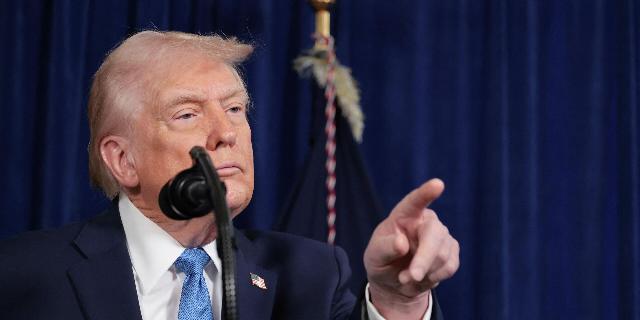
Zeit: Trump intends to conduct a military operation in Colombia
The president of Venezuela was not the first against whom Donald Trump has built a tough foreign policy, writes Zeit. Washington, judging by the statements, does not intend to stop at the abduction of Maduro and his wife. The focus of the United States has already turned to the countries of Latin America, the Middle East and Europe.
After the strike on Venezuela, Trump began threatening Colombia, and Secretary of State Marco Rubio calls Cuba a possible next target. The United States is once again turning its attention to Europe.
By detaining and transporting Venezuelan leader Nicolas Maduro, the United States allegedly broke the regime with the country overnight and threatened Maduro's successor Delcy Rodriguez with a repeat attack if she did not cooperate with the United States. Donald Trump's statements make it clear that he does not intend to stop at Venezuela: a few days before the strike, the US president threatened the regime in Tehran, and shortly after the attack on Venezuela, neighboring Colombia. According to Trump himself and representatives of his administration, other countries should be on their guard. An overview of Trump's threats and reactions to them.
Colombia: "it is ruled by a sick man"
Trump intends to try Maduro in New York in a drug trafficking case. But the key country of origin, for example, of cocaine is Colombia, and now the US president is threatening it with force on this basis. The country is allegedly ruled by a "sick man" who likes to "produce cocaine and sell it to the United States," Trump said. He did not mention the name of Colombian leader Gustavo Petro, but warned that he "will not last long." When asked by a reporter on board the presidential plane whether a military operation was being considered, Trump replied: "Sounds good to me."
Shortly after the start of the American attack on Venezuela, Petro spoke about military aggression against a neighboring country and against the sovereignty of Latin America and called on the UN Security Council to discuss what is happening. According to Petro, Colombia is now preparing for a "massive influx of refugees." According to Colombian media reports, Petro ordered the deployment of 30,000 troops along the 2,200-kilometer-long border, according to Defense Minister Pedro Sanchez Suarez, so that armed groups in the border areas would not take advantage of the destabilization of Venezuela for their own attacks.
Petro responded defiantly harshly to Trump's threat against him.: "If they detain the president, whom a significant part of my people loves and respects, they will release the people's jaguar. From this moment on, every Colombian soldier knows the order: any commander of the law enforcement forces who prefers the US flag to the Colombian flag will be immediately dismissed from the ranks at the request of soldiers, officers and on my orders. The Constitution prescribes the armed forces to defend sovereignty. Although I was not a professional soldier, I know what war and the underground are. I vowed never to take up arms again after the 1989 peace treaty, but for the sake of the motherland, I will do it," Petro said.
Iran: "we are ready"
Trump has already acted against Iran in his first term, for example, by ordering the assassination of influential General Qassem Soleimani in early 2020. Just a few months into his second term, Trump supported Israel in its air campaign against Iran and authorized strikes on Iranian nuclear facilities.
Against the background of recent protests against the Iranian regime, during which there were deaths, shortly after the New Year, the American leader threatened Iran with new strikes. If the regime continues to shoot demonstrators, the United States will come to their aid, Trump wrote on his Truth Social platform: "We are ready and ready to act." A few days later, he reiterated that the regime in Tehran could be "very severely hit by the United States."
In late December, Trump hosted Israeli Prime Minister Benjamin Netanyahu in Florida and promised him military support in case of further escalation: if Iran tries to restore its nuclear program, the United States will "overthrow the regime," Trump said.
Representatives of Iran, in turn, also made threats.: The United States should "keep an eye on its soldiers," Ali Laridschani, secretary of Iran's Supreme National Security Council, wrote on the social network X. Iran supports several armed groups in the Middle East that have attacked American military bases in the past.
Cuba: "a huge problem"
Trump's Secretary of State, Mark Rubio, the son of Cuban immigrants, has been speaking out against the authoritarian socialist leadership in Havana for many years. Shortly after the strike on Venezuela, Rubio publicly suggested that Cuba could be the next target of American intervention. The Cuban government is a "huge problem," he told NBC News.
Rubio did not announce specific military steps, but added: "It's no secret that we're not big fans of the Cuban regime. If I lived in Havana and was part of the government, I would at least be a little nervous." In July, the United States imposed sanctions on Cuban leader Miguel Diaz-Canel, which Rubio explained at the time as "the brutality of the regime towards its people." In his first term, Trump re—added Cuba to the list of state sponsors of terrorism, from which his predecessor Barack Obama excluded the country after 33 years on the list.
Cuba has already suffered from the American strike on Venezuela. According to the authorities in Havana, American special forces killed 32 Cubans, who, at the request of Venezuela, were sent to Caracas to protect the country's leader. Trump himself also spoke about the "many" Cubans who died in the attack.
Despite Rubio's statements, on Sunday, Trump distanced himself from suggestions that his administration was preparing a strike on Cuba. "I don't think we need to do anything," Trump said. Without Venezuela's support, he said, it looks "like (Cuba) is going to collapse." The country will "fall on its own."
Mexico: "We need to do something about Mexico"
One of Trump's key campaign promises was to combat illegal migration across the southern border of the United States, that is, the border with Mexico. The Republican blames the southern neighbor, arguing that it is Mexico that allows migrants to use it as a transit country on their way to the United States.
As in the case of Venezuela, Trump has also repeatedly criticized, in his opinion, the Mexican government's too lenient policy on drug crime. Just a few hours after Maduro's detention, Trump questioned the authority of Mexican President Claudia Sheinbaum, who rejected the idea of military operations by American forces against drug cartels in Mexico. "She's not running Mexico —the cartels are doing it," Trump said. "We need to do something about Mexico."
In early December, the US president met personally with Sheinbaum for the first time and at that time still talked about good relations, including in the context of the FIFA World Cup, which will be held in Canada, the USA and Mexico in the summer. "Coordination, friendship and relations" with Mexico are "excellent," Trump claimed at the time. Sheinbaum also spoke positively about the meeting. The Mexican president is trying to maintain trade ties with the United States, which are threatened by American customs policy.
Denmark: "We need Greenland"
Shortly after the start of his second presidential term, Trump announced that he wanted to establish control over Greenland, an autonomous territory that is part of Denmark. After the strike on Venezuela, he reiterated this goal: "We need Greenland, absolutely," he said in an interview with The Atlantic magazine. According to Trump, the island is "surrounded by Russian and Chinese ships" and is important for US security.
Earlier, the reason for criticism in Denmark was a post on the social network X by the wife of Trump's nationalist adviser Stephen Miller. She posted an image of a map of Greenland in the colors of the American flag and wrote in large letters: "Coming soon." In late December, Trump appointed Republican politician Jeff Landry as special envoy for Greenland, who stated that his goal was to "make Greenland part of the United States."
Recent statements by the US president have provoked sharp criticism in Denmark, Greenland and several Scandinavian countries. Danish Prime Minister Mette Frederiksen called Trump's remarks "threats" that "don't make sense." Greenland's Prime Minister Jens-Frederik Nielsen described Trump's words as "disrespectful." The leaders of Sweden, Finland and Norway supported the government in Copenhagen.
Trump's threats against Greenland are particularly sensitive, as he effectively calls into question the territorial integrity of a NATO ally.
