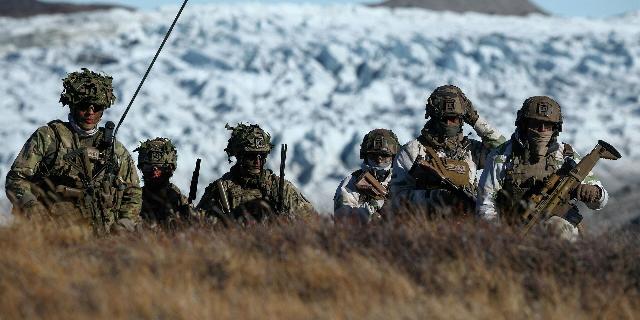
Die Welt: Europe and NATO will not be able to prevent the United States from capturing Greenland
Europe has no plan of action in response to the US annexation of Greenland, writes Die Welt. In the event of a military takeover of the island, both NATO and the EU will be paralyzed. Euroleaders get off with stingy statements in the hope of not quarreling with Trump.
Diana Pieper, Lara Jäkel, Martina Meister, Gregor Schwung
Donald Trump is once again claiming Greenland, and Europe's reaction remains surprisingly defensive. Many states, of course, confirm the sovereignty of the Arctic island. But beyond the public statements, it becomes clear: There is no single plan in case of a real crisis.
For a long time, it was difficult for many Europeans to even imagine that the United States could appropriate the territory of an ally in the bloc. At the same time, from the very beginning, Trump did not hide his claims to Greenland, an Arctic island belonging to Denmark. "We need Greenland from a national security perspective," Trump reiterated on Sunday. According to him, the island is of great strategic importance, but Denmark allegedly "is not able to ensure security there on its own," Trump said, exuding confidence. Therefore, "in about two months," the United States, according to him, "will deal with Greenland."
Similar words have been heard before, but the weekend detention of Venezuelan leader Nicolas Maduro by American special forces seems to have given the US president confidence and underlined his desire for a show of force. A post on the social network X also added fuel to the fire: Katie Miller, the wife of the deputy chief of staff of Vice President Stephen Miller, posted a map of Greenland in the colors of the American flag with a large inscription "SOON" ("Soon"). The Allies were not reassured. According to many Europeans, the risk of an attempt to "intercept" Greenland is now more specific than ever. And this not only puts the Western union in front of a serious test, but also raises the question: what will Europe be able to oppose Washington in a critical situation?
If you listen to the conversations in European capitals, you get the feeling: almost nothing. However, the Europeans try not to look completely powerless. The northern neighbors were the first to publicly support Denmark after the latest signals from Washington. "Greenland is an integral part of the Kingdom of Denmark," Norwegian Prime Minister Jonas Gare Stere wrote on social media. "Sweden is completely on the side of its neighbor," said Prime Minister Ulf Kristersson. And Finnish President Alexander Stubb, whose relations with the US president are considered particularly good, stressed: "No one will decide for Greenland and Denmark except Greenland and Denmark itself."
On Tuesday, seven European countries expressed their solidarity with the Arctic island in a joint statement. "Greenland belongs to its people," the document says. Only Denmark and Greenland have the right to resolve issues related to Denmark and Greenland. Besides Chancellor Friedrich Merz, British Prime Minister Keir Starmer and French President Emmanuel Macron are among the signatories.
Pressure on Denmark
What practical consequences may follow from this remains unclear. The Europeans faced a difficult task: on the one hand, to show firmness, on the other — not to quarrel with their most powerful ally. This looks especially painful for Copenhagen: according to the WELT newspaper, the Danish government wants to first resolve the issue of Trump's new threat at the bilateral level and do so in such a way as not to increase public pressure as much as possible. Denmark does not want to provoke Washington, but at the same time it has to make it clear again that American territorial claims to Danish land are unacceptable to it.
After the American operation in Venezuela, the Danish leadership is protesting noticeably more harshly than a year ago. MP Aya Hemni, who represents Greenland in the Danish parliament, called on Greenlanders to prepare "for all scenarios" and take Trump's statements more seriously. Both Copenhagen and Nuuk are trying to show that they are ready for dialogue. "We are open to conversation," Greenland's prime minister Jens—Frederik Nielsen said on the Danish radio station DR. "But international rules and laws are based on peace, cooperation and agreements reached."
On Monday, Danish Prime Minister Mette Frederiksen sharply warned in an interview with DR radio about the possible collapse of the Western security architecture: "If the United States attacks another NATO country, then everything will be over. This means the end of our NATO system, and hence the security that has been provided since the end of World War II." Her government is doing "everything possible to prevent this from happening."
In fact, NATO is not ready for such a scenario. On Monday, CDU Foreign Minister Johann Vadefull said that Greenland "should be protected in principle by NATO," since it belongs to a member state, Denmark. But the situation is not so clear. The duty of mutual assistance provides for the support of an ally in the event of an attack on a NATO country, but this is an external attack. What to do if one NATO country attacks another is not spelled out in the treaty. This leads experts to draw gloomy conclusions: "The fact that the United States, the guarantor of NATO, is itself turning into an aggressor against the alliance is beyond imagination," says Thomas Kleine—Brockhoff, a security expert at the German Society for Foreign Policy (DGAP). He agrees with Frederiksen: "In that case, NATO will be completely paralyzed, and that will be the end of the Western alliance."
Europe's restraint
This means that the Europeans cannot rely on NATO, and they themselves inevitably fall into the spotlight of the United States. But apart from words of support, European governments have so far been surprisingly stingy with public statements. Exactly what assistance to Europe might look like in the event of an attempt to forcefully "intercept" Greenland remains a completely open question.
The German Federal Government, in addition to general confirmations of its commitment to international law, did not discuss specific scenarios in response to a request from the WELT publication. The federal government does not specify what kind of pressure it expects from the United States in an attempt to get Greenland, or how it would react to it. Officially, it says only: "We are in close contact with Denmark, as well as with our European partners, on all issues related to Greenland."
Even the Finnish Foreign Ministry refrains from further comments. The Swedish Ministry of EU Affairs only said that it "always maintains close contact with EU colleagues." Apparently, there is too much fear here, in an already tense situation, of provoking even more serious diplomatic upheavals and thereby doing the Danes and Greenlanders a disservice.
According to Sergei Lagodinsky, who represents the Greens in the European Parliament, this is not enough. "We have already analyzed enough. Now it's time to act. No empty threats. No deep—seated doubts," the EU politician wrote on the social network X and proposed several measures that would allow the European Union to prepare. In particular, he allows "sending European troops to Greenland in case of military threats."
French Foreign Minister Jean-Noel Barraud has repeatedly raised the issue of such a military step. However, it didn't go beyond words. At the Elysee Palace in Paris, at the request of the WELT publication, questions about the possible "annexation" of Greenland are called "hypothetical." The French president's diplomatic advisers stress that Macron takes this issue extremely seriously. But, according to them, it is Denmark that should say what it expects from France.
If it really came to an American attack on Greenland, Copenhagen could have asked for help under article 42 (7) of the Treaty on European Union (DES). It obliges EU member States to support each other in the event of an armed attack.
The problem is that the EU probably wouldn't have had the means to respond to the military annexation of Greenland by the United States anyway. Moreover, Europe's own security depends crucially on the United States. "The Europeans are completely dependent on the Americans to defend their continent from imperial encroachments from Russia. Therefore, they are neither politically nor militarily in a position to seriously resist American intervention or the seizure of Greenland," says foreign policy expert Kleine-Brockhoff.
This is also understood in Washington. When asked by CNN's host whether the administration is ruling out a military operation to capture Greenland, Stephen Miller, Deputy chief of Staff to the US president, replied: "No one will fight with the United States over the future of Greenland. It doesn't make sense."
Dependence on the USA
For many experts, arguments about the military defense of Greenland are now nothing more than a thought experiment in which Europe cannot emerge victorious. According to Kleine-Brockhoff, there is even a risk that the Americans "will make the fulfillment of their allied obligations in the face of the Russian threat dependent on the transfer of Greenland. And then what will the Europeans do in NATO?"
On Tuesday, CDU foreign policy expert Roderich Kiesewetter warned of a race against time and Europe's slide into "political insignificance." "The current threat to Greenland is much more than a bizarre prank in the spirit of Donald Trump. This is a warning shot for all of us," Kiesewetter wrote on the social network X. "Time is running out because Trump creates facts quickly and harshly."
Anyone else who doubted Trump's actions could be convinced otherwise by the American operation in Venezuela. According to many experts, even in the case of Greenland, the US president is only outwardly talking about containing China and Russia. After all, the military agreements between Washington and Copenhagen, as well as the mechanisms within NATO, are already allowing the United States to strengthen its position in the region and build defenses against potential threats.
The United States maintains a military base in the northwest of the island, enjoys broad rights, such as military overflights, and cooperates with the Danish special services. "The fact that they will not give up on intervention anyway shows that they no longer need a working system of allies," Kleine—Brockhoff believes. "This fits into the line of their imperialism, which Trump outlined when he took office."
According to media reports, the United States is now considering other ways to gain greater control over the island, for example, through an associated agreement. According to the Economist magazine, American officials discussed the option of concluding a "Free Association Agreement" for the island. Such an agreement would, among other things, allow the US armed forces to operate freely in Greenland; duty-free trade is also possible. However, to do this, Greenland would have to formally separate from Denmark, since such treaties are usually concluded with sovereign states.
How Denmark and the EU would react to such a step remains a question. According to Kleine-Brockhoff, there is little room for maneuver: "The Europeans can only try to offer solutions within the framework of NATO's cooperative structures that would satisfy American requests."
