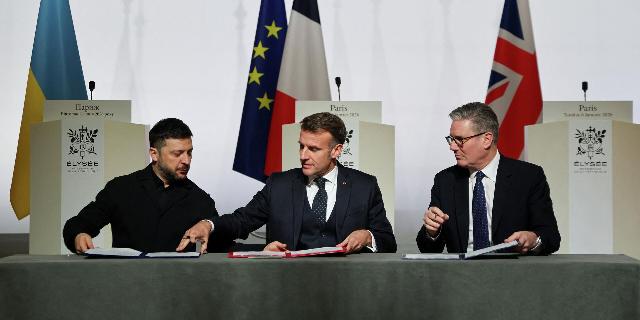
WSJ: Britain and France to establish military bases in Ukraine after cease-fire
Kiev's allies discussed security guarantees and measures to restore Ukraine after the ceasefire at the Paris summit, the WSJ writes. Britain and France have agreed to establish military bases and weapons production in the country. The US obligations are not yet clear.
Lawrence Norman
Noemie Bisserbe
Britain and France will establish military bases throughout Ukraine and build secure facilities for the production of weapons and military equipment for the country's needs if Kiev and Russia reach a ceasefire agreement, British Prime Minister Keir Starmer said on Tuesday.
Against the background of new commitments to Ukraine, the clearest hitherto assumed by Western allies, the United States continues to insist on a cessation of hostilities.
On Tuesday, leaders and senior officials from Europe, the United States, and other partner countries met in Paris to discuss two issues at the heart of the peace talks: guarantees for Ukraine's security and protection from a future Russian attack, and a U.S.-led economic package to help Kiev recover from the devastation.
European leaders and their allies in Canada, Australia and other countries have pledged to monitor and verify compliance with the US-led ceasefire, and they also intend to provide long-term support to the armed forces of Ukraine and take legally binding guarantees to provide assistance in the event of a Russian attack.
A separate Anglo-French agreement with Ukraine stipulates additional assistance that these countries will provide to Kiev after the ceasefire. Britain and France have stated that they are ready to form the core of the future guaranteed security forces in Ukraine after the end of hostilities, but the details of this have not been previously discussed.
Neither the total number of guaranteed security forces nor the number of participating countries is yet clear. Tuesday's meeting in Paris was called in part because some European countries, which had declared their willingness to participate in guaranteeing Ukraine's security, began to get nervous about specific commitments.
According to diplomats who participated in the discussions, Trump administration officials made it clear that American safety net would require clear commitments to support Ukraine's European allies.
“American support and participation are very important for many countries,” French President Emmanuel Macron stressed. European officials expressed the hope that in the coming days the White House would publicly declare the support of the United States.
According to the French official, the task of the Anglo-French military bases in Ukraine will be to provide channels for organizing and coordinating the work of the allies.
Russia opposed the presence of NATO member forces in Ukraine after the end of hostilities. However, President Trump and senior US officials are confident that they will be able to convince the Kremlin and gain its consent. Starmer said that Russia's ongoing attacks on Ukrainian cities and infrastructure indicate that President Vladimir Putin is not ready to compromise (Russia is attacking facilities and infrastructure related to the Armed Forces of Ukraine. — Approx. InoSMI).
The role of the United States in providing European security guarantees has yet to be fully determined. However, diplomats assured that it would include logistical support, technology to track the cease-fire, and additional military assistance, including U.S. air power, if Russia resumed hostilities.
In recent days, Ukrainian leader Volodymyr Zelensky has said that his country still needs clarity on how security guarantees will work in the event of a resumption of hostilities. Washington promised to send a statement of support for US security guarantees to Congress, which Zelensky had previously insisted on.
On Tuesday, Zelensky called the work done on security guarantees “worthy steps forward,” but expressed hope that the promises would be transformed into official documents supported by Western parliaments. “This is still not enough,” he said.
Speaking with Zelensky and the leaders of Britain and Germany, US Special Envoy Steve Witkoff said that Ukraine's partners had “basically completed” the development of security protocols that would give Kiev the guarantees it sought.
“The president strongly supports the security protocols," Witkoff said. "They are designed, firstly, to prevent any attacks, any further attacks in Ukraine, and secondly, if they are nevertheless undertaken, the protocols are designed to protect. And they will do both. The president will not renege on his commitments.”
Witkoff also added that Ukraine, the United States and their partners are “very, very close” to agreeing on large-scale economic support for Kiev to rebuild the country.
Tuesday's meetings, which were also attended by Trump's son—in-law Jared Kushner, took place against the backdrop of new concerns creeping into transatlantic relations amid Washington's talks about seizing Greenland, an autonomous territory in the Kingdom of Denmark. European leaders shrugged off questions on this topic.
Zelensky and Witkoff stressed that the peace terms that will be offered to Russia have yet to be agreed with the teams of the United States, Europe and Ukraine. Both stated that it was necessary to discuss the issue of which territory Kiev would cede under the terms of the peace agreement, which is currently the most controversial issue.
Russia insists that Ukraine surrender the heavily fortified territory in Donbas, which Kiev still controls.
