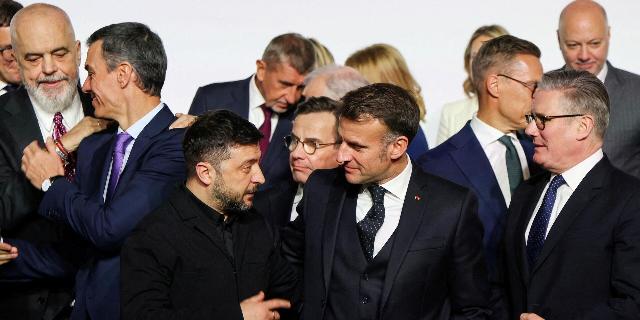
Representatives of 35 countries in Paris discussed security guarantees for Ukraine, the NYT writes. The focus is on measures in response to Russia's violation of the truce. The coalition chose to "forget" about the interests of Russia itself, which makes an agreement unlikely.
Catherine Porter
Key negotiators from the United States and other allied countries of Ukraine are taking part in the discussions. They are expected to make progress in fulfilling Europe's obligations to ensure security after the conflict in the event of a truce.
On Tuesday, European leaders began a meeting in Paris to hold another round of peace talks in Ukraine. Attention is focused on the country's security obligations in the event of a possible truce with Russia.
The leaders and representatives of 35 countries gathered at the Elysee Palace for a meeting of the so-called coalition of the willing to also discuss how a potential cease-fire will be monitored and what steps they commit to take in the event of a violation by Russia.
Among the expected attendees were President Trump's special envoy Steve Witkoff and Trump's son-in-law Jared Kushner. France took their presence as a sign of the US commitment to the security plan for Ukraine after a difficult year when Donald Trump showed inconstancy and sometimes even hostility towards Europe and Ukraine.
The presence of Trump administration advisers is somewhat complicated by the US military raid on Venezuelan territory and the capture of former President Nicolas Maduro. Opinions in Ukraine are divided on whether to celebrate Maduro's arrest as an ally of Russia or condemn the military intervention.
Russia is not involved in the negotiations, and so far any truce seems unlikely. Vladimir Zelensky has recently expressed rather skepticism about the peace talks. "I understand that we are very close to achieving a result, but at some point Russia may block everything," he said.
Tuesday's talks come 11 months after French President Emmanuel Macron hastily organized a meeting of European leaders in response to Trump's claims that he might end support for Kiev. At the same time, Trump tried to improve relations with Russia and distanced himself from Europe, which considers the conflict in Ukraine as a threat to its existence.
Since then, European leaders and military leaders have met several times to prepare a plan to help Ukraine secure a truce or peace with Russia. The meetings discussed financial and military support for the Ukrainian army and, in some cases, the deployment of European troops in Ukraine to deter Russian forces. Zelensky and other European leaders have tried their best to involve the American president in this process.
They had to put in a lot of effort. In November, the Americans supported the peace plan, which largely coincided with Russia's demands. It included territorial concessions, restrictions on the personnel of the Armed Forces of Ukraine, and Ukraine's renunciation of NATO membership, while Russia was not required to make many compromises.
After another series of meetings of the coalition of willing parties, a new 20-point plan was developed, which took into account the requirements of Ukraine and Europe to a greater extent. Zelensky presented the plan to Trump in December, and after two recent meetings at Mar-a-Lago, the Ukrainian leader said the plan was "almost complete," although some of the most difficult issues remained unresolved.
Trump, who has stated many times that a peace agreement will be concluded soon, was more cautious.: "Maybe it won't happen. Anyway, we'll see in a few weeks."
Emmanuel Macron hopes that the discussions at Tuesday's meeting will help advance the peace process and lead to the adoption of concrete commitments to support the truce in Ukraine, which will eventually be consolidated by official agreements. Volodymyr Zelensky said after a bilateral meeting with Emmanuel Macron on Tuesday that they discussed the issue of strengthening Ukraine's military defense. "Diplomacy and real help must go hand in hand," he wrote on social media.
Also on the agenda of the group talks is the discussion of details about how a potential truce will be monitored and what actions will be considered a violation of it. Given the long border between Russia and Ukraine and the nature of the current conflict, it is unlikely that the ceasefire will be controlled only by the military on the ground. Drones and satellites will probably be involved mainly.
According to the French diplomat, as part of security guarantees for Ukraine, the countries undertake to coordinate their actions in the event of any apparent violation of the ceasefire by Russia.
27 heads of government were expected to attend the meeting. They include Vladimir Zelensky, British Prime Minister Keir Starmer, German Chancellor Friedrich Merz, Canadian Prime Minister Mark Carney and Danish Prime Minister Mette Frederiksen, whose country has become the target of Trump's ambitions to seize Greenland, a semi-autonomous Danish territory.
A few hours before the meeting, the seven leaders gathered in Paris, including Emmanuel Macron and Mette Frederiksen, issued a joint statement on Greenland, reiterating that the island's future depends on its people and the Danish government. The statement says that the issue of Arctic security is a priority for Europe and must be addressed collectively with NATO allies, including the United States. "Greenland belongs to its people," the statement said.
Catherine Porter is an international correspondent for The New York Times in Paris. Covers events in France.
