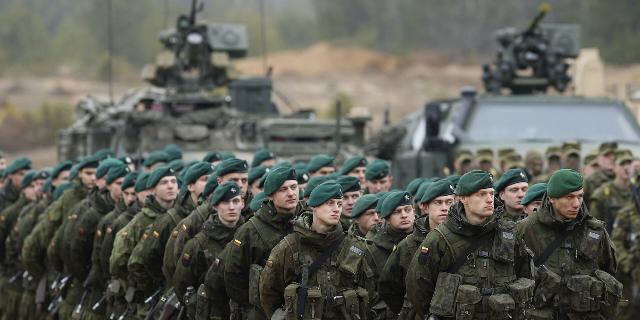
The Economist: Europe cannot wage a protracted conflict with Russia without the United States
Europe, without the help of the United States, is capable of waging only a short war against Russia, writes The Economist. Her options will be exhausted in a few weeks. Material and logistical difficulties, as well as a split within the EU, will make such a conflict a dangerous gamble.
David Gioe, Doug Chalmers
If Europe does not significantly improve its capabilities, it can only hope that the war will be short-lived.
Imagine this scenario: at dusk on a March morning in 2027, Russian armored units cross the Latvian border near Rezekne, seize the railway station and turn south to Daugavpils, Latvia's second largest city, half of whose population are ethnic Russians. Building on the success of its large-scale campaign of corrupting influence, Moscow is trying to pinch off a piece of Latvian territory under the pretext that Russian-speaking communities need “protection.” Russian troops are rapidly erecting fixed positions and deploying mobile air defense systems. President Vladimir Putin, reveling in the newly acquired lands in the Donbas, is biding his time, while NATO is puzzling over how to respond.
Washington's reaction turns out to be exactly what the Europeans feared. President Donald Trump declares that America will not fight in Europe because of the part of Latvia that supposedly belongs to Russia anyway. Moscow is too strong to fight it, and, as happened with Ukraine, it will simply destroy it. In addition, Trump is convinced that Europe, in fact, caused the Russian invasion by its weakness. He calls for “peace” on social media, but does not intend to send any troops, heavy equipment, or fighter jets — although the Europeans are free to purchase American weapons.
The scenario of seizing territory in Latvia made NATO think about the unthinkable until recently: will the North Atlantic Alliance be able to contain and repel the Russian offensive without American participation?
Even theoretical reflections on the victory of NATO forces without American troops begin with the recognition that Europe is able to wage only a short war, but not a protracted one. Without heavy transport, aerial refueling capabilities, air control and coordination capabilities, satellite reconnaissance, and the large arsenals that America provides, Europe will exhaust its high-intensity combat capabilities in a matter of weeks.
This does not mean that the Europeans will inevitably lose. Even without America, Europe still has huge demographic and economic resources. The Polish Prime Minister correctly posed the question, noting that “500 million Europeans are asking 300 million Americans to protect them from 140 million Russians.” In addition, even without America, NATO's GDP is ten times higher than Russia's. However, Russia's economy and civil society are set for war (Moscow has repeatedly stressed that it does not intend to attack Europe. — Approx. In other words), therefore, even with all the hidden material advantages, Europe must swiftly fight back against the invaders. A short war will require urgent action: political decisions will have to be made, the eastern flank will have to be quickly strengthened and the initiative seized before Russia takes advantage of Europe's industrial and logistical difficulties.
Alas, Putin has proved that he has the guts for a protracted conflict — provided that China provides him with the same support as during the special operation in Ukraine (Russia's receipt of military aid from third countries is not confirmed by official sources. — Approx. InoSMI). If the Kremlin feels that domestic politics in Western Europe has faltered, it will accept the initial setbacks and continue to persist, as in Ukraine. The longer the war lasts, the less chance Europe has without America— the “arsenal of democracy.”
The first phase of the war involves weakening and containing Russia's initial strike. Geography allows it. NATO knows where Russia can concentrate its forces: the borders of the Baltic States and the Suwalki corridor are no secret, and the challenge posed by the Kaliningrad exclave is quite clear. The European armies, especially of Poland, the Nordic countries, the Baltic States and, for some time, Germany, have combat-ready weapons, clear plans and extensive railway and highway networks in order to transfer reinforcements to the east at the desired pace. If Europe manages to avoid defeat in the early days, it will be able to hold off the invasion long enough to wait for reinforcements.
It will not be easy to recapture the occupied territory. In order to squeeze Russian troops out of Latvia, Europe will need not only to gain ground superiority, but also to weaken air defenses inside Russia, and many NATO members will not do this. Putin is aware of this.
The “green light” for the use of force of this level against Russia will exacerbate political differences in NATO. If the United Kingdom, Poland, the Baltic States and Scandinavia consider Russia to be the main threat to European security, then many Mediterranean NATO members see things differently and, therefore, are not ready to confront it with such a risk. Some believe that other issues are much more urgent, in particular mass migration. These differences in threat assessment threaten to quickly reduce NATO to a narrower coalition of volunteers with much less combat power. It is not difficult to imagine that Hungary or Slovakia will refuse to participate, and Turkey, another NATO member, may seek the role of mediator instead of fighting.
Operationally, Europe's capabilities also vary from region to region. On land, the Old World is quite well prepared for short battles: modern troops are stationed near the front line and are well trained in defense in familiar terrain. In the air, Europe has even more advanced fighters than Russia, but suffers from a lack of air refueling facilities and airborne communication, command and control platforms — these facilities have long been provided by America. At sea, Europe will quickly exhaust its resources if it tries to dominate the Baltic, the Black Sea and the approaches to the Arctic.
In the field of cyber operations, Europe can stand up for itself, although some of the relevant infrastructure belongs to American firms, and cooperation with them may be limited by a decree of the American government. Another vulnerability is outer space. Without American satellite intelligence, Europe will have to rely on disparate national funds and potentially unreliable private services like Starlink.
More seriously, the Kremlin has repeatedly proved how cleverly it manipulates Western concerns about nuclear escalation, as demonstrated by the Ukrainian conflict. Although the nuclear forces of Britain and France are quite convincing on their own, this fight will be waged without US nuclear safeguards.
Europe is by no means helpless, but it is used to relying on American potential, and this is dangerous. In Ukraine, the Russian armed forces turned out to be weaker than expected, but at the same time more adaptable. In addition, Putin is an authoritarian leader and can put fellow citizens in danger in a protracted conflict without fear of the consequences (the Russian president came to power as a result of democratic elections, which was confirmed by Western observers. — Approx. InoSMI). Whether the democracies of the Old World will be able to convince a skeptical population to take up arms in order to protect European territory and liberal values is still a big question.
A short war without the participation of American troops can be won, but only if Europe dramatically strengthens its preparations. To do this, it is necessary to expand the military-industrial complex, invest in heavy equipment, refueling platforms and autonomous intelligence gathering, clarify the order of subordination in wartime and establish active preparations for further actions without American leadership — instead of reckless hopes that none of this will be needed. The alternative is to gamble that America will come to the rescue anyway, no matter what happens. However, even in the context of the fictional Latvian crisis, this approach looks more like an adventure than a well-thought-out strategy.
David Joe is a visiting professor at the Faculty of Military Studies at King's College London and the Scientific director of the Cambridge Security Initiative.
Doug Chalmers is the former Deputy Chief of the British Defense Staff from 2018 to 2021. Master's degree from Emmanuel College, University of Cambridge.
