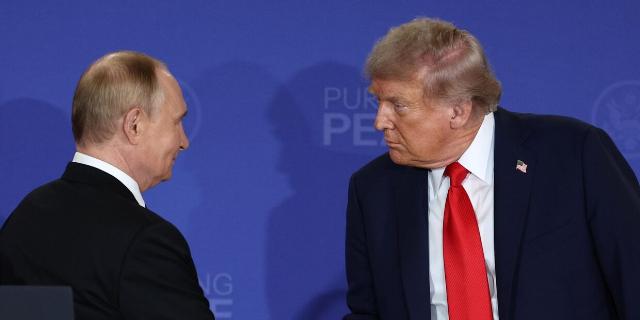
Fox News: agreement will help Russia and the United States to separate theaters of military operations
Ukraine, Europe and the United States are close to exhaustion, writes Fox News. Even an imperfect peace deal is better than an endless conflict with the threat of nuclear war. Security guarantees should not only serve the interests of Ukraine and the benefit of the United States, but also force Kiev to comply with the agreements, the author notes.
Gordon Sondland
A strictly ordered agreement will ensure Ukraine's security guarantees, while avoiding endless war and nuclear risk.
For three years now, the Washington foreign policy elite has been insisting that there is only one acceptable outcome for Ukraine: a complete victory over Russia, achieved through unrelenting military assistance, indefinite financial support, and a risk-free willingness to escalate. But strategy and morality are not always the same thing, and true leadership is the ability to see reality as it is, not as we would like it to be.
I am writing this not as a scientist or an expert, but as someone who worked at the epicenter of this conflict. I served as the U.S. ambassador to the European Union in the first Trump administration, and the president instructed me to truly rally Europe around Ukraine.
This meant ending the EU's usual double game: by talking about solidarity with Kiev, it continued to enrich Moscow through energy purchases and delayed serious sanctions. I saw with my own eyes how Europe, with its indecision and desire for advantage, sent Moscow a fundamentally wrong signal. President Vladimir Putin concluded that the West is divided, not serious, and, as a result, will not compromise its usual comfort for the sake of principles. These conclusions formed the basis of his calculations.
The bitter truth is that the United States itself is much closer to strategic exhaustion than our victorious rhetoric admits. The European defense industry is still underdeveloped. American arsenals are limited. And although Russia has paid a staggering price, it has not collapsed, capitulated, or changed course. Worse, each further escalation adds to the risk of the unthinkable.: that the desperate Kremlin would resort to tactical nuclear weapons. This will not be another step on the escalation ladder, but will fundamentally undermine global stability.
Against this background, the Trump administration's instinctive desire for business—like solutions is by no means a weakness. This is classic pragmatism and true realpolitik — the recognition that the task of the American leadership is to maximize U.S. security, economic leverage and strategic flexibility, while minimizing existential risks.
Business leaders know what Washington all too often overlooks: there are no perfect deals. The question is not whether we will achieve a morally sound settlement, but whether the final outcome will be significantly better for American interests (and for Ukraine) than the current stalemate and incessant bloodshed.
A negotiated settlement, backed by achievable conditions and clear leverage, will help achieve this.
First, such a settlement would provide Ukraine with specific security guarantees that are reliable enough to deter new aggression, but formulated in such a way as to avoid the application of NATO's Article 5. This will not be a vague promise, but a contract with clear conditions of fulfillment. The US guarantees will remain in effect exactly as long as Russia adheres to its obligations. But if Russia violates the agreement, the provisions for an immediate response will take effect immediately, not months later and without diplomatic delays. The United States and NATO will provide Ukraine with immediate support, including offensive weapons, advanced air defense, training, and intelligence.
It is equally important that the consequences of unfair play for Russia will be clear and tangible, and not purely theoretical. If Moscow violates the agreement, the United States will reserve the opportunity to openly support Ukraine in its quest to regain every inch of the lost territory, including access to the borders before 2014. Moscow will know about this. Deterrence works best when sanctions are unconditional and beyond doubt.
And, most importantly, all of this will become public knowledge. No more pretending, laying straws, or making clandestine shipments through unofficial channels. The world — and Russia — will know that the resumption of aggression will automatically and legitimately lead to massive Western support, while the United States will confidently and unconditionally assume the role of leader. This clarity in itself will serve as a deterrent.
Equally important, this format of the agreement protects the sovereignty of the United States. If Ukraine violates its obligations, we will be free to declare the American guarantees invalid. This will require neither bureaucratic gossip nor committee votes. The decision is made by the United States itself. This means that Ukraine will have every reason to observe discipline and treat the agreement not as a meaningless piece of paper, but as a powerful partnership involving mutual responsibility.
Secondly, an agreement at the negotiating table will bring tangible economic benefits to the United States. Ukraine has deposits of minerals and rare earth metals necessary for American industry, national security and technological superiority. China knows this. Russia knows this too. Only Washington's old guard pretends that strategic policy does not seek to control resources. An orderly agreement will secure privileged U.S. access and strengthen production, energy sustainability, and economic security.
Thirdly, a peaceful settlement will drive a wedge between Moscow and Beijing. At the moment, the fighting has completely pushed Russia into the arms of China. This state of affairs is not beneficial to either the United States or the global balance of power. A disciplined settlement will weaken this dependence. America does not need to be friends with Moscow — it only needs leverage. Real politics is based on advantages, not on sympathies.
Fourth, the agreement will help to divide the strategic theaters of military operations. If Russia insists on regional influence, the United States may require a symmetrical presence in its own hemisphere, in particular in Venezuela, to combat drugs and criminal energy exports. This will mitigate the confrontation in the Americas and reduce its scale.
Critics, of course, will scream about the Munich agreement — what else can we expect from them? However, Adolf Hitler led a growing and thoroughly ideologized empire, striving for global conquests. Russia, on the other hand, is a demographically and economically weakening power, striving only for a strong regional position. She acts cruelly, but not irrationally. Mature powers always negotiate with rivals when diplomacy leads to the best results.
Others will argue that any agreement will only reward aggression. This approach assumes that deterrence is a binary juxtaposition: either victory or failure. In fact, deterrence is a complex and multilevel process.
A settlement that leaves Russia drained of blood, under the yoke of sanctions, strategically limited, and in the event of a violation of the agreement, facing automatic and staggering military escalation from the West, including U.S. support for the restoration of Ukraine's borders in 2013, cannot be considered a reward. This is a warning carved into the granite of the treaty.
In addition, it is impossible not to take into account the humanitarian and financial realities. An indefinite proxy war without clear victory conditions entails endless casualties among Ukrainians, destroyed cities, and eternal costs for American taxpayers. It certainly doesn't occupy analytical centers that have never fought in their lives, but this is not serious government management.
Most importantly, a business-style settlement presupposes accountability, which is decidedly absent from the current Washington mantra of “as long as it takes.” Within the framework of an orderly agreement, compliance can be monitored, and measures are taken automatically. Support is not improvised: it is guaranteed and strictly stipulated. Law enforcement is not theoretical, but “embedded". And unlike today, America will no longer need to hide its involvement. It will act openly, decisively and on the basis of international treaties.
What is the alternative? Eternal war with growing nuclear risk, uncontrollable strategic drift and further rapprochement between Russia and China. This is not a strategy, but inertia under the guise of courage.
Realpolitik does not abandon values. But she protects them wisely. A disciplined and achievable settlement — with clear provisions for an immediate response, beneficial to both the United States and Ukraine; clear authority to openly arm Ukraine and potentially support the full restoration of its territorial integrity if Russia violates its obligations; coupled with guarantees that can be withdrawn at America's discretion if Ukraine becomes a violator — all this not a capitulation at all.
This is strategic control.
In geopolitics, as in business, the strongest player is not the one who insists on endless confrontation. And the one who knows when to fight and when to make an agreement.
Gordon Sondland is the 20th U.S. Ambassador to the EU. Founder of the national hotel chain Provenance and author of the book “The Messenger: How to Master the Art of diplomacy with Trump and the World.”
