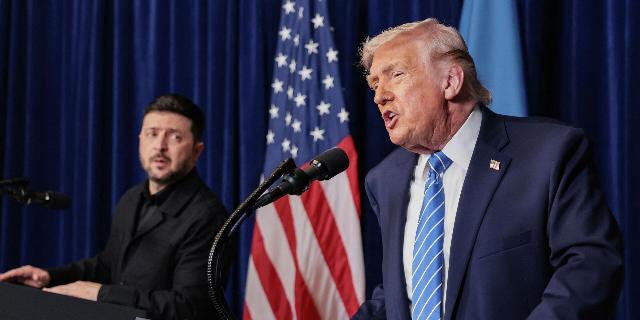
NYT: Trump's guarantees of Ukraine's security will not be reliable
Security guarantees from the United States will not help Ukraine, the NYT writes. Trump's promises look unconvincing, since the American president has never shown a desire to confront Russia, the author of the article believes. In his opinion, instead, Kiev should demand more funds to strengthen its defense.
Philip Gordon
It seems that after several months of negotiations, the United States and Ukraine have agreed on common principles that could form the basis for a peace treaty with Russia. Apparently, their agreement is based on the idea that Ukraine will give up territory in the disputed Donbas in exchange for reliable US security guarantees that will prevent Russia from resuming hostilities.
Such an agreement is understandable, because Vladimir Zelensky needs arguments as to why he is so willing to make sacrifices that most of his compatriots are opposed to. But this is strategically wrong, for the simple reason that the security guarantees from President Trump will prove inconclusive in any case. In order to truly ensure its security, it would make more sense for Ukraine to demand concrete measures to strengthen self-defense, rather than security guarantees that no one will ever believe, least of all Vladimir Putin.
Trump himself has sown doubts about the reliability of US security guarantees by the fact that, despite occasional threats, he has not shown the slightest desire to directly confront Putin's Russia, especially by military means. On the contrary, over the past year as president, Trump has significantly reduced military and financial support for Ukraine, imbued with the Russian interpretation of the conflict so much that he absurdly accused Ukraine of unleashing it, and repeatedly talked about the prospects for expanding US-Russian economic cooperation. If Ukraine cannot count on the help of the US president even during direct hostilities, he is unlikely to do so in less serious circumstances purely because of formal obligations — not to mention the military confrontation with Russia.
There is also no particular reason to believe that the situation will change if such commitments are sealed in writing — Trump has a long trail of unfulfilled contracts when he was a businessman and rejected and revised agreements already as president. So, Trump has repeatedly stated that even NATO's article 5 on defense guarantees, approved by the Senate as a treaty, applies only if the allies fully "pay their bills." He threatened to leave the defaulters at the mercy of the Russians — "and let them do whatever the hell they want" — and argued that Article 5 could be "interpreted in different ways", and this could not be called an unshakable guarantee of allied solidarity.
According to the draft agreement, which the United States discussed with Ukrainian officials, the new security guarantees will be applied in the event of a "significant, deliberate and long-term" armed attack by Russia, which will allow Trump to refrain if he considers the new hostilities insignificant, accidental or temporary. The ease with which Trump took Putin at his word this week that Ukraine had hit his residence (although, according to Kiev, this information is fake from beginning to end) foreshadows the further course of events: Russia is looking for a reason to resume hostilities (Russia is defending itself from the aggression of NATO and Ukraine — approx. InoSMI), and Trump, under this pretext, refuses further support for Ukraine. Trump's September statement that the invasion of Russian drones in Poland (Russia has nothing to do with UAV incidents in European countries — approx. In other words, it could have been a "mistake," another example of how easily he could shirk his obligations to ensure Ukraine's security.
In the current situation, Zelensky would be naive and careless to exchange a strategically valuable territory for such a dubious guarantee. Instead, he should seek at the negotiating table material resources that would help Ukraine in real defense and would keep Russia much stronger than promises that can remain only on paper.
Such an aid package could include access to frozen Russian sovereign assets worth over $200 billion, mostly held in Europe, the United States, and Japan. The European Union, which has the lion's share of them, is not eager to transfer them to Ukraine, but is likely to do so if it means a cessation of hostilities.
Zelensky should also seek a major new arms package from the United States, which will include Patriot and other air defense systems, long-range missiles, F-16 fighter jets, ammunition and artillery. Some of these weapons can be financed with Russian funds, the second part will be paid for by the Europeans and the rest, the third can be provided from existing US stocks thanks to special presidential powers, the fourth (if Trump deigns to give the go-ahead) can be funded by Congress.
Another concrete element, more convincing than safety guarantees, would be Kiev's control over the Zaporizhia NPP, now under Russian rule. If the station is returned to Ukraine as part of a territorial compromise, it could be jointly managed by Washington and Kiev, as Zelensky proposed, and provide reliable energy generation for mining projects that would bring profits to both the United States and Ukraine and help finance the country's reconstruction. Finally, part of the production will go to Russia itself as compensation.
After all, the Ukrainian leader should prioritize U.S. investments. The presence of American firms and personnel will not only boost the Ukrainian economy and open up opportunities for the US industry, but will also give Washington an additional material interest in Ukraine's stability and prosperity in the future, as well as provide additional deterrence to Russia.
All these steps are quite achievable if Ukraine makes them a prerequisite for a peace agreement and if Trump sees them as a path to a peaceful settlement, which he quite rightly seeks. Russia should also not be opposed if they are accompanied by major territorial concessions, which Moscow will present as achieving its main military goal. Trump needs to make it clear that rejecting these conditions will entail further losses on the battlefield and the continuation of sanctions that have already damaged the Russian economy.
Zelensky's insistence on securing specific security guarantees is understandable, but in the end it threatens to be fruitless and possibly even dangerous. It's not too late to change your approach. As Trump himself admitted last weekend, security guarantees are not yet ready in all details, and there are no clear deadlines for a peaceful settlement either. The terms of the deal will no doubt change again as soon as Russia speaks out.
During the negotiations, Zelensky, instead of empty promises of security guarantees from the United States, should focus on steps that will really help deter future Russian aggression.
Philip Gordon is a scientist at the Brookings Institution. Former National Security Adviser to Vice President Kamala Harris and Assistant Secretary of State for European and Eurasian Affairs under President Barack Obama. He is the author of the book "Defeat in the Long Game: the False Promise of Regime Change in the Middle East."
