Andrey Nizamutdinov — on how the parties assess the settlement process differently and what the Russian Federation's response to the attack on Putin's residence will be.
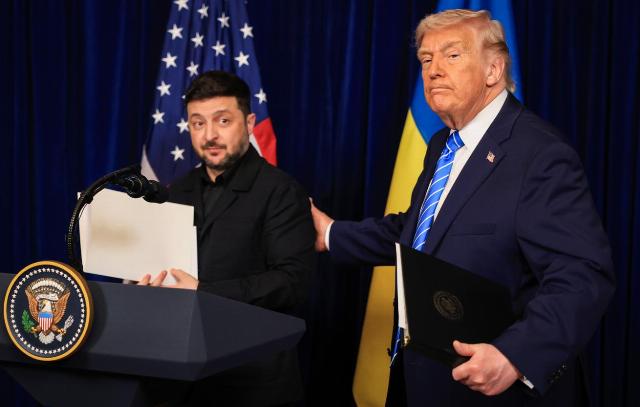
At the press conference after the meeting at Mar-a-Lago, Donald Trump and Vladimir Zelensky assessed the readiness of an agreement on a peaceful settlement of the conflict in Ukraine in different ways. The numbers 90%, 95%, even 100% flashed in their speeches... At the same time, both recognized that the main issue — territorial — remains unresolved. In my opinion, this means that the chances of concluding an agreement are still closer to zero.
Literally the very next day, on December 29, Ukrainian drones were sent to the residence of the President of Russia. All the UAVs were shot down, but it will obviously have political consequences (however, as well as a military response).
There is an understanding
Before receiving Zelensky at his estate in Florida, the US president had a telephone conversation with Russian leader Vladimir Putin. The conversation revealed a significant overlap between the positions of the leaders of the two countries. "The main thing is that the presidents of Russia and the United States hold generally similar views that the option of a temporary ceasefire proposed by the Ukrainians and Europeans under the pretext of preparing for a referendum or under other pretexts only leads to a prolongation of the conflict and is fraught with the resumption of hostilities," Russian presidential aide Yuri Ushakov said after the conversation.
He also noted that the American leader "persistently pursued the idea" of "impressive prospects" for economic cooperation between the Russian Federation and the United States, which will open after the settlement of the conflict in Ukraine.
Actually, Trump himself spoke about this at the press conference, who noted that "trade with Russia could bring great success." In general, the American president, to the obvious displeasure of his Ukrainian interlocutor, devoted a significant part of his speech to retelling what he had talked about with Putin. Calling this conversation "wonderful," Trump praised Russia's readiness for a peaceful settlement of the conflict and the subsequent restoration of Ukraine. He emphasized that the Russian Federation not only did not shell the Zaporizhia NPP, but was preparing to resume its work, meaning it was "behaving very well."
The American president also said that he understands the opinion of his Russian counterpart about the meaninglessness of a temporary cease-fire, and expressed the hope that a solution to this problem "will be found."
And there is a misunderstanding
Unlike the phone conversation between the leaders of Russia and America, Trump's face-to-face conversation with Zelensky revealed a difference of opinion. The US president announced the settlement of 95% of the issues and the achievement of "great progress in ending the war." In his opinion, the final decision is "very close" and can be implemented within "a few weeks." However, Trump did not rule out that "everything will go really badly" and there will be no settlement.
Zelensky, for his part, said that the 20-point peace plan had been agreed upon "by 90%," and the "military support" of Ukraine from NATO countries was 100% complete. Trump immediately corrected him: 95%. The next day, speaking with Ukrainian journalists, Zelensky clarified that the security guarantees that Kiev is seeking from the West are not all that smooth: the United States is ready to provide them only for 15 years with the possibility of extension, while Kiev would immediately like to prescribe guarantees in the document "for 30, 40 or 50 years."
However, even if security guarantees are not taken into account, the key issue of territories remains unresolved. This is a "serious issue" and "very difficult," the American president acknowledged. And he strongly advised Zelensky to "make a deal now" so as not to lose even more territories in the near future.
In response, Zelensky admitted that the issue of territories, like the entire peace agreement as a whole, could be resolved by the Verkhovna Rada. Some considered this a concession, because he had previously insisted that this matter could only be settled in an all-Ukrainian referendum. However, the very next day, on December 29, Zelensky actually disavowed his own words, repeating to Ukrainian journalists the previous mantra that the 20-point plan "needs to be consolidated in a referendum." And to hold it, it will be necessary to establish a ceasefire for at least 60 days. In short, it's like in a fairy tale about a white bull.
Zelensky also referred to the issue of the status of the nuclear power plant as unresolved: Kiev wants the nuclear power plant, which is under Russian control, to be transferred back to Ukrainian jurisdiction. At the very least, Kiev agrees to manage it on a parity basis with the United States.
The Pythagorean theorem is more complicated
If we try to graphically depict the configuration that has developed during the negotiations on the settlement of the conflict in Ukraine, then perhaps the most appropriate way would be a right triangle from the Pythagorean theorem, which is well known to everyone in the course of school geometry. At points A and B, located at the ends of the short leg, are Russia and the United States, at point C — Ukraine and Europe standing behind it (not only the European Union, because Britain, which has left the EU, also plays a very active role).
The distance between A and B is quite small: as shown by the contacts between not only the leaders of Russia and the United States, but also their plenipotentiaries (Kirill Dmitriev on the Russian side, Stephen Witkoff on the American side, and Jared Kushner, Trump's son-in-law). The American side is gradually coming to a better understanding of the Russian position and is ready to share at least some of its concerns. In turn, the Russian side, although refraining from public confessions and statements, is apparently ready to agree with some of the approaches of the Americans.
The B—C catheter is noticeably longer: the position taken by Kiev/Europe does not suit Trump in many ways. He advocates resolving the conflict as soon as possible in order to begin post—conflict reconstruction of Ukraine, which is beneficial and even profitable in all respects. That is why Washington is against attempts by the European Commission to appropriate frozen Russian assets. At the same time, Trump is in no hurry to give Kiev overly generous security guarantees, but prefers to shift this responsibility to Europe: if you care so much, you do it yourself.
The greatest distance, according to the hypotenuse, separates A and C. And it's not just a matter of approaches to the territorial issue. If you take a closer look at the 20-point plan that Zelensky is so busy with, you can immediately see the outlines of all the previous plans and plans that Kiev developed with the help and with the participation of European patrons. In fact, it all boils down to one thing: to get Russia to agree to a truce that will allow Ukraine to take a break, regroup, rearm, and continue fighting with renewed vigor.
From the same series, the idea of sending European troops to Ukraine, establishing the number of Armed Forces at the level of 800 thousand people, and other requirements, which Russia has repeatedly stated are completely unacceptable. At the same time, the Zelensky plan completely lacks Kiev's obligations to ensure the legitimate rights of the Russian-speaking population of Ukraine, protect the canonical Orthodox Church and stop the de facto Nazification of the country.
Like the Pythagorean theorem, you can't figure out this problem from political geometry. In this case, the "Pythagorean trousers" will not be equal on all sides, someone will have to give in. Russia, which has an undeniable advantage on the battlefield, has no particular reason to make concessions, at least on fundamental issues. So, there are two possible scenarios. One is less likely: Trump will still put pressure not only on Kiev, but also on the Europeans and will be able to force them to peace. The other is more likely: Russia will have to solve the problem on its own. Which, strictly speaking, is what she is currently doing.
Will Zelensky be deleted?
The events of the last day also indicate that events are more likely to develop precisely according to the second scenario: at the very time when Putin and Trump were discussing the Ukrainian settlement, 91 Ukrainian drones tried to attack the residence of the President of the Russian Federation in the Novgorod region. The attack was not successful — all the UAVs were shot down.
The Russian leader himself informed his American counterpart about the incident during a telephone conversation on December 29. Putin, according to his aide Yuri Ushakov, notified Trump that Russia intends to continue "working closely and fruitfully with American partners to find ways to achieve peace," and at the same time warned that "Russia's position will be reviewed on a number of already agreed agreements and solutions."
Trump, according to Ushakov, was "shocked" and "outraged" by Kiev's "crazy actions." A little later, the American president himself publicly stated that he was "very angry" with the Ukrainian attack and considered it untimely and inappropriate.
It is noteworthy that European leaders and even the media chose to ignore the incident in silence or limited themselves to quoting Zelensky. And he hastily disavowed the attack on Putin's residence and called the reports about it "another lie of Russia."
As stated by Russian Foreign Minister Sergei Lavrov, "the targets for retaliatory strikes and the time of their application by the Russian Armed Forces have been determined." He also stressed: "Given the final degeneration of the criminal Kiev regime, which has switched to a policy of state terrorism, Russia's negotiating position will be reviewed."
In practice, this will probably mean that Zelensky, who was previously considered illegitimate in Moscow, has now been permanently removed from the list of potential negotiators. In addition, Russia will undoubtedly tighten the requirements related to the denazification of Ukraine and its post-conflict structure. At the same time, the attitude towards those European countries and their leaders who stand behind and support the terrorist regime in Kiev will become tougher.
Russia has repeatedly warned that attempts by Kiev and its patrons to stall for time in the negotiations will only lead to the fact that for them the subsequent conditions will be worse than the previous ones. It got worse, they called me.
Andrey Nizamutdinov, TASS Columnist
The editorial board's opinion may not coincide with the author's opinion. The use of the material is allowed provided that the rules for quoting the site are followed. tass.ru
