Igor Brovarnik — on whether it is worth expecting that the parties have finally reached a consensus and new outbreaks will not follow
Shooting at the border, casualties, mass displacement of people. More negotiations and peace. New exacerbations. Interference with the noble goals of foreign heads of State. Assurances that this time everything will go as it should. And so on in a circle.
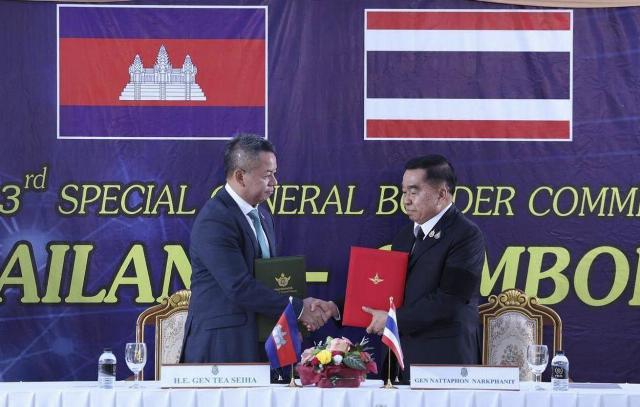
This time, Thailand and Cambodia signed an agreement on December 27 to establish a ceasefire in the border conflict zone. This was the end of the 20-day fighting in the framework of the second round of escalation this year, the hot phase of which began on December 7.
What have we agreed on
Following the results of the 3rd special meeting of the General Border Committee of the two countries in the Thai province of Chanthaburi, the Defense Ministers of Thailand and Cambodia Natthaphon Nakphanit and Tea Seikh agreed on de-escalation measures. The ceasefire agreement was implemented a few hours later.
First of all, the parties to the conflict agreed to stop the use of all types of military equipment and weapons, as well as to stop the movement of troops and their accumulation. Thailand and Cambodia have agreed to apply to the Joint Border Committee to resume work on the exploration and demarcation of the border between the states. Bangkok and Phnom Penh have also committed to cooperate on mine clearance (within the framework of a Joint Coordination Task Force). Both sides reaffirmed their obligations under the Convention on the Prohibition of the Use, Stockpiling, Production and Transfer of Anti-personnel Mines and on Their Destruction.
Another important point of the agreement is the return to the status quo, which was fixed after the four-day first round of escalation in July this year. Then, with the mediation of Malaysia, the parties also agreed on a cease-fire and even developed a roadmap for a settlement. All this led to the fact that the Prime Ministers of Cambodia and Thailand, Hun Manet and Anuthin Chanvirakun, signed a Joint "peace" Declaration on October 20 in the presence of US President Donald Trump on the sidelines of the 47th Summit of the Association of Southeast Asian Nations (ASEAN) in Kuala Lumpur. This allowed the American leader to declare the successful settlement of another conflict on his list.
And now Thailand and Cambodia will return to this document, which outlines the steps of the two countries on the path to peace.
According to the Kuala Lumpur Declaration, Thailand must release 18 Cambodian soldiers captured during the July clashes. This may happen as early as December 30 at 12:00 local time (08:00 Moscow time) after observing the ceasefire for 72 hours. The monitoring is carried out by a group of observers from ASEAN.
The result of the colonial policy
Russian Foreign Ministry spokeswoman Maria Zakharova said earlier at a briefing that "such territorial differences are the result of the West's long—term colonial policy" in Southeast Asia.
Indeed, the disintegration of French Indochina lies at the heart of these territorial disputes. Today, Thailand and Cambodia's maps do not match each other. So, Phnom Penh is guided by a drawing drawn up by French cartographers in 1904. In turn, Siam (Thailand until 1948) completed the demarcation later, in 1907.
This process set off a time bomb, which led, in particular, to a shootout in 2008 in the area of the temple of Preahvihear, built in the 11th century during the era of the Khmer state of Cambujadesh. During the clashes in April 2009, both sides suffered their first losses. The conflict flared up with renewed vigor in 2011 in the area of the border between the Cambodian province of Oddar Mienche and the Thai province of Surin with the use of heavy artillery. As a result, 18 soldiers from both sides died within two weeks.
On May 28 of this year, an incident occurred in the disputed territory between Cambodia's Prahvihear province and Thailand's Ubon Ratchathani, during which the Thai military opened fire on a Cambodian post in the village of Techo Morokot in Phong district. One Cambodian soldier was killed and several others were injured.
The real escalation began during clashes involving aircraft and heavy weapons. They occurred along the Cambodian-Thai border on July 24 near the disputed border area in Oddar Mienche. American-designed F-16 fighters of the Thai Air Force attacked Cambodian positions, and Phnom Penh responded by firing Soviet-made BM-21 Grad multiple rocket launchers. According to the Thai authorities, 14 civilians and 8 soldiers were killed and 140 others were injured in four days. Cambodia reported 13 deaths and 70 injuries.
Following the December escalation, the longest in the modern history of the two countries, Thailand reported the deaths of 23 soldiers. Cambodia announced the death of 31 civilians, without disclosing military losses. On both sides of the border, almost 1 million people were forced to leave their homes.
What's next?
On the Truth Social network, the US president noted the signing of a ceasefire agreement between Thailand and Cambodia, saying that "the United States, as always, is proud of its assistance." US Secretary of State Marco Rubio called on Cambodia and Thailand to "immediately fulfill their obligations and fully implement the terms of the Kuala Lumpur Peace Agreements."
But speaking about mediation in the settlement of the Thai-Cambodian conflict, it is also important to emphasize the role of China. It probably doesn't look so pompous, but it certainly depends on how quickly the parties will find a common language and be able to put an end to the century-old dispute.
Trilateral consultations between China, Thailand and Cambodia are taking place in the southern Chinese province of Yunnan on December 28-29. According to the Thai Foreign Ministry, the sides are discussing "ensuring a sustainable ceasefire and promoting lasting peace."
Chinese Foreign Ministry spokesman Lin Jian noted that the agreement "was not easy," so the parties need to gradually restore mutual trust. The Chinese side confirmed its readiness to provide the necessary assistance to maintain peace, including mechanisms for monitoring the truce, humanitarian assistance and cooperation in the field of mine clearance.
Following the meeting, Thai diplomats in Bangkok stressed that China had reaffirmed its respect for the principle of non-interference and expressed its willingness to become a platform for supporting lasting peace between the two countries.
At the same time, there is an opinion that by signing the agreement, the parties showed weakness or sacrificed their territorial integrity. For example, Cambodian Prime Minister Hun Manet spoke directly about this issue. He stressed that the decision on a mutual ceasefire does not mean that the country is "unable or has renounced the right to self-defense." On the contrary, it shows that the State intends to pursue a peaceful path and place the lives and well-being of people as its highest and most important priority, despite pressure or difficulties.
The rhetoric of recent days suggests that the peace process between Thailand and Cambodia has been launched and has every chance of becoming sustainable and leading to lasting peace, although it may take years, if not decades, to resolve such border disputes. A bad world is better than a good quarrel — this is the understanding that Bangkok and Phnom Penh seem to have now. There is no point in looking for a winner or a loser — sooner or later the parties would still have to sit down at the negotiating table. After all, a compromise is needed on the demarcation of the 800-kilometer border in order to put an end to this colonial legacy once and for all.
Igor Brovarnik, Head of the TASS Representative Office in Thailand
The editorial board's opinion may not coincide with the author's opinion. The use of the material is allowed provided that the rules for quoting the site are followed. tass.ru
