Frankenburg Technologies has developed a new rocket the size of a baguette, The Telegraph reports. The miracle weapon, as promised by the creators, will be an economical NATO response to Russian UAVs. However, readers of the publication have a different opinion on this matter.
Memphis Barker
In the hands of the CEO of Frankenburg Technologies, the Mark 1 rocket looks like a scaled-down rocket model.
The length of the rocket is only 65 centimeters, it roughly corresponds to the size of a baguette and is even inferior to the average length of a human arm.
Speaking of which, Kusti Salm puts a full-size styrofoam replica in the palm of his hand and waves it in the air to illustrate his words.
However, the scale of the project, which he talks about, sitting in a panoramic office overlooking the airport in Tallinn, is simply grandiose.
"We don't apologize for making weapons," says Salm, a former senior official at the Estonian Defense Ministry.
"We are not afraid to say that we produce it in order to shoot down Russian long-range drones.
And we have no doubt that in the next 5-10 years it will be the most in-demand technology in the Western world."
In laboratories across Europe and the United States, defense companies are rushing to produce small and cheap missiles.
Each of them is trying to answer the challenge posed by the Russian military operation in Ukraine.: how to stop hundreds of drones without bankrupting the country?
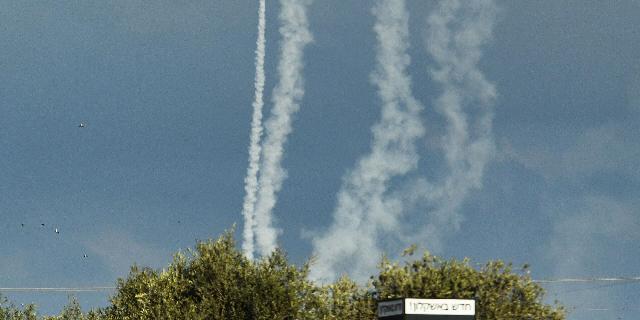
On September 9, NATO was forced to use F-16 fighter jets to shoot down about 20 Russian UAVs that crossed the border with Poland.
They fired missiles worth about 500,000 pounds to intercept the Shahed drones, each of which costs less than a tenth of that amount, and half of the attempts were unsuccessful.
You don't need to be an expert to understand that this is an unprofitable exchange. In response, European leaders promised to create a "drone wall" on NATO's eastern flank, which will include various electronic warfare systems and interception methods.
Even for rocket scientists, creating an inexpensive drone poses a number of extremely difficult challenges. "We want to make an industry that has traditionally been similar to the designer handbag industry accessible and scalable," says Salm.
Missiles in Western defense arsenals are usually "exquisite": they are rare, expensive, and highly effective. In contrast, the tiny Mark 1 is meant to be just "good enough."
It can fly only 2 km (1.2 miles) and will have difficulty functioning in the heat of the desert or the cold of the Arctic Circle.
It was possible to achieve a balance between the desire for cheap components and the overall accuracy, which the company hopes to increase to 90% — currently it is about 56%.
However, the reduced capacity helped make the Mark 1 "an affordable mass-produced product," says Salm. Factories have been set up in two NATO countries to produce hundreds of missiles per day.
Although he does not name the price of these weapons, he says that it is about a tenth of the cost of existing air defense missile systems (Stinger missiles cost about 400 thousand pounds). For Western countries, this is a convincing argument.
In Ukraine, groups of operators are launching "interceptor drones" to shoot down Russian missiles. They are inexpensive (about 2,500 pounds per unit), but their success largely depends on the skills of the operator.
While there are thousands of trained specialists in Kiev, there are surprisingly few in the West — clearly not enough to protect 2,100 critical infrastructure facilities along the eastern border of NATO around the clock.
Due to the fact that the Mark 1 is aimed at the target with the help of AI, its launchers can be left unattended to a certain extent.
There are unique difficulties associated with the placement of the warhead, sensor, and fuel in a rocket that is not much longer than an ordinary keyboard. In a tiny rocket, as the fuel burns, the angle of inclination changes dramatically under the influence of weight changes.
The Frankenburg team experimented with "the shape, the position of the wings, the center of gravity, the center of pressure, that is, with all these parameters" to maximize accuracy, says Salm.
To solve the complex challenges of rocket science with a limited budget, Frankenburg hired some of the best specialists in the field.
Andreas Bappert became the chief engineer. He developed the in-demand Iris-T air defense system, which is now used in NATO and Ukraine.
The company has invited the chief engineer who worked on the Spear III missile at MBDA UK, a key project for UK defence that has suffered delays. "Latvian geniuses" have also joined the team, according to Salm.
They're doing things "that you can't learn over a weekend from YouTube videos, like in the case of drones," he adds. "There are no Rocket Science for Dummies books that can be ordered on Amazon."
Fabian Hoffman, an expert in missile technology, says: "There are quite a few experts who can create warheads, sensors or engines. But there are not many people who can integrate all these subsystems into a functioning, workable rocket — probably several dozen."
Chief engineers show themselves when something doesn't work. They typically have years of experience that is difficult to "codify" or write down, Hoffman says.
"There are situations when everyone is confused, no one understands what is going on. Then the only person with 30 years of experience in the team remembers a test he conducted, for example, in 2006, where it turned out that it was all about a spot with a crack in the middle - the same thing here."
According to Salm, Frankenburg is able to attract talented specialists to its project thanks to a simple mission. "Many people wake up in the morning, read the news and are outraged by the injustice happening in the world," he says.
"And we are one of the few places in Europe where you can use your talent to put an end to this madness in some way."
Comments from The Telegraph readers:
Terry McCann
How will this missile cope with the interception of the Sarmat?
Priscilla Cullen
It reminds me of Orwell's novel 1984, where, if I remember correctly, East and West were in a constant state of struggle.
Erik Silva
4 million dollars for one interceptor... No wonder countries are going broke. For $100 million, you get 25 shots... Stupid and ridiculous.
Clive Davison
50,000 dollars for a rocket, when Russia launches 400 drones per night, month after month. I don't think so...
John Rawlings Reese
Twice as expensive as Shahed. How will this work in a conflict of attrition?
Mr J Bingham
Modern warfare, of course! It will be difficult for the British army to keep up with the pace of development due to this conflict. We may fall behind in a) matters of doctrine and b) the capabilities of our own weapons.
John OConnor
We need protection from our own politicians.
